Nursing Student Represents UKZN at African Conference
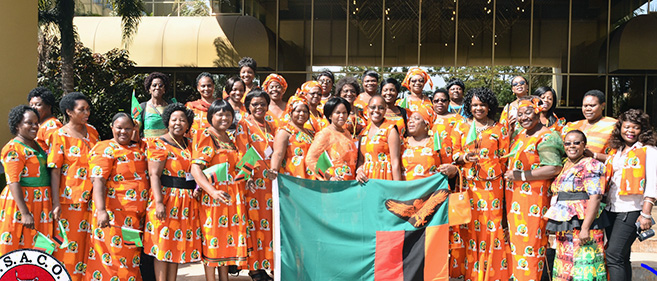 UKZN Nursing student Ms Bupe Mwamba (extreme right) with Zambian delegates at the recent ECSACON Conference.
Ms Bupe Mwamba, a final-year student in the Bachelor of Nursing Advanced Practice Programme in Midwifery and Neonatal care on UKZN’s Howard College campus, presented a paper on the topic of newborn care at the 2014 East, Central and Southern Africa College of Nursing (ECSACON) Conference held in Harare, Zimbabwe earlier this month.
ECSACON and its partners organised the 11th Scientific Conference and 5th Quadrennial General Meeting which brought together Nursing staff from all ECSACON member countries, including representatives from the International Council for Nurses (ICN) and International Council for Midwives (ICM), to discuss issues pertaining to improving maternal, newborn and child health, and strengthening healthcare systems.
The theme for the Conference was “Increasing access to quality nursing and midwifery care: nurses and midwives taking the leading role”. Innovations and excellence in nursing and midwifery were discussed, along with evidence-based primary healthcare practices/approaches.
Mwamba’s topic was: “Scaling essential new-born care”. ‘Every human life is precious regardless of how it came about, hence quality of care at every stage of human life is critical,’ she said. ‘Neonatal care has remained a challenge in many African countries … This has been due to a lack of trained neonatal nurses as experience is enhanced with specialisation.’
Early neonatal death refers to the death of an infant within the first week. ‘There is a need to scale up essential newborn care as 85.7% of ECSACON member countries have a double-digit figure when it comes to neonatal mortality rates, while only 14.28% have a single figure,’ said Mwamba.
Essential interventions involve adequate care of the mother, including nutrition, education and healthcare, while antenatal interventions include tetanus toxoid immunisation and iron, iodine and folate supplementation.
During labour, delivery and the first few hours of the infant’s life, a clean environment was necessary, with temperature maintenance and emergency obstetric care on hand for any complications. Mwamba also specified that over the next four weeks after birth, exclusive breastfeeding and skin-to-skin contact between the mother and child was vital. ‘Cord care and hygiene is important, with early recognition of danger signs and prompt care-seeking,’ she said.
Mwamba discussed short- and long-term plans for neonatal care, suggesting the implementation of non-costly short-term measures such as the creation of job descriptions for staff in neonatal units.
A long-term plan would be the introduction of a degree in Neonatal Nursing Science to build capacity among staff in neonatal units, with midwifery as a pre-requisite qualification for the course.
Zakia Jeewa
author : .author email : .UKZN Community Encouraged to Make Use of Ombud’s Services
 UKZN’s Ombud, Justice Zak Yacoob.
UKZN’s Ombud Justice Zak Yacoob has encouraged students and staff members who have complaints or concerns about alleged unfairness or injustice, particularly those that have a reputational risk to the University, to come forward and exercise the services of the Ombud’s office.
The Ombud’s office was established in July 2010 to provide the UKZN community with an independent, neutral dispute resolution resource that deals with complaints and concerns in a fair and equitable manner.
A former justice of the Constitutional Court, Justice Yacoob was appointed almost a year ago as the second Ombud after the passing of former Chief Justice of the Constitutional Court Justice Pius Langa. His role is to act as an independent dispute resolution official who is authorised by the University to confidentially receive complaints, concerns, or inquiries about alleged acts, omissions, improprieties, and/or broader systemic problems within his or her jurisdiction, and to listen, offer options, facilitate resolutions, informally investigate or otherwise examine these issues independently and impartially.
Council has recently approved the revised Terms of Reference, which define the jurisdiction, operational procedures and bounds of the University Ombud. Yacoob commended the University for accepting and implementing his recommendations in respect of certain matters.
Giving an overview of the operations of the office since he took over, he said it was a fairly good year. He noted that there were enough complaints and concerns to justify the existence of the office. However, he said he was surprised that the number of complaints was relatively low compared to other institutions with Ombud’s offices.
There were a high number of cases shortly after the office was established, he said, but this figure had since decreased. He also stated that it was concerning that a large number of complaints were Human Resources related matters from staff members.
‘The office of the Ombud is a last resort after all internal remedies have been exhausted. Internal structures and policies should be able to resolve such issues,’ he said.
He added that only if stakeholders are not satisfied with the outcome of internal processes, and only after all the existing mechanisms have been exhausted, can they come to his office. He said it is not right that UKZN is involved in so many court cases as this places harm on the reputation of the University.
The scope of matters that can be brought to the Ombud’s office is covered under the Terms of Reference. More information regarding the duties and functions of the UKZN Ombud and the detailed Terms of Reference are available on http://ombud.ukzn.ac.za/Homepage.aspx or contact the Ombud’s Office Manager, Advocate Busisiwe Mngoma, at ombud@ukzn.ac.za.
Sithembile Shabangu
author : .author email : .Geology Student Recognised for Presentation at Golden Key International Summit
.This Article has been removed until further notice.
author : .author email : .Visiting Education Academic Shares Expertise in Self-Study Scholarship
 TES project participants attend the self-study research dissemination and writing for publication workshop.
Dr Anastasia Samaras, an international education scholar with an extensive repertoire of teaching and research activity in self-study scholarship, was recently hosted by the School of Education as a Foreign Research Fellow.
Samaras is Professor of Education in the Graduate School of Education, College of Education and Human Development at George Mason University, Virginia. During her visit, she facilitated a two-day ‘Self-study research dissemination and writing for publication’ workshop for a group of 40 master’s and doctoral students and research supervisors.
Samaras shared her expertise in the research methodology of self-study of practice for a range of activities aimed at supporting the development of self-study research capacity.
‘The students and supervisors are all participants in the Transformative Education/al Studies (TES) project that aims to support academic staff members in Higher Education Institutions who are pursuing master’s and doctoral degrees using the approach of self-study of educational practice,’ said the School’s Dr Kathleen Pithouse-Morgan.
Workshop participants also included academic staff members from diverse disciplines across six South African universities including UKZN.
Samaras was the expert guest facilitator of a second two-day workshop aimed at introducing 13 early career academics from UKZN to self-study as a methodological approach to the scholarship of teaching and learning.
Her expertise and enthusiasm were greatly appreciated by those who participated in the workshops and seminar with one of the participants stating, ‘I intend to write, write, write. This was truly motivating!’
Samaras’s visit was made possible by funding from the South African National Research Foundation, UKZN’s Teaching and Learning Office, and the Durban University of Technology’s Research Office.
Melissa Mungroo
author : .author email : .Anthropologist Joins Editorial Board of Prestigious Journal
 Dr Maheshvari Naidu, an Anthropologist in the College of Humanities.
Dr Maheshvari Naidu, an Anthropologist in the College of Humanities, has been invited to join the editorial board of the prestigious journal, Anthropology Southern Africa.
Anthropology Southern Africa, which positions itself as a journal committed to critical anthropology, is now published by Taylor and Francis.
Naidu said she was happy to accept the invitation. The journal ‘speaks from Southern Africa while also reaching out to and attracting international scholars from the North and, importantly, the Global South who are active in Southern African scholarship,’ she said.
As the Editors, Professors Heike Becker, Sherine Van Wyk and Kathleen McDougall point out in their editorial note, the journal ‘is committed to a southern African reach and encourages ethnographic and theoretical work coming out of Angola, Botswana, Madagascar, Malawi, Mozambique, Namibia, South Africa, Swaziland, Zambia and Zimbabwe’.
The 2014 issue introduces the new editorial board which Naidu has been invited to join, and which includes the internationally acclaimed Harvard-based Anthropologists, Jean and John Comaroff, as well as other internationally and regionally established Anthropologists.
According to Naidu the journal is committed to contemporary perspectives in social and cultural anthropology and in cognate interdisciplinary scholarship. ‘It aims to provide a voice to public debates on current conditions in Southern African, African, and global societies and publishes across a range of topics such as cities and urbanism, new religious movements, popular culture, social media, neoliberalism, nationalism, racism, social memory, protests and social movements, health and illness, and human rights.’
Naidu has had two papers published in the journal: Glaring Invisibility: Dressing the Body of the Female Cleaner (32: 2&3; 2009) and Performing Illness and Health: The Humanistic Value of Cancer Narratives (35: 3&4, 2012).
Melissa Mungroo
author : .author email : .Zelda la Grange Delivers Peter Brown Memorial Seminar at UKZN
 Ms Zelda la Grange delivering her presentation.
Ms Zelda la Grange, known around South Africa for her role as Personal Assistant to Nelson Mandela, delivered the Peter Brown Memorial Seminar at UKZN’s Pietermaritzburg campus on 17 September.
The annual seminar, arranged by the Alan Paton Centre & Struggle Archives to coincide with Heritage Month, has been aimed since 1997 at commemorating the contributions of liberals, like Peter Brown who founded the Liberal Party, to ending apartheid.
The seminar was followed by a book launch and signing for la Grange’s recently published book, Good Morning, Mr Mandela, co-ordinated by Exclusive Books, Pietermaritzburg.
La Grange, who played an important role in the life of South Africa’s most revered leader, chose to centre her contribution to the seminar on the wealth of memories she has of Madiba, while acknowledging how he would have smiled upon the event for its remembrance of unsung heroes like Brown who need to be recognised and honoured for their contributions.
La Grange’s presentation, titled “Pursuing your passion”, highlighted some of the most memorable and formative lessons she learnt during her 19 years in Mandela’s employ. La Grange focused on Madiba’s demonstration of three values which guide her outlook on life: to act with courage and conviction, to treat everyone with respect, and to demonstrate discipline in one’s conduct.
La Grange made it clear that her goal in telling her part in the Madiba story was to ensure that the valuable lessons she had the privilege to learn from him are not forgotten.
She described having to find courage upon meeting Mandela to realign her convictions as a young, ignorant Afrikaner girl, and said that the courage and conviction which motivated men like Mandela, Paton and Brown should inspire all South Africans.
La Grange also spoke of the former President’s graciousness and respect in addressing her in her own language when they first met.
‘I heard him say over the years that when you speak to a man, you speak to his head; when you speak to a man in his language, you speak to his heart. He spoke to my heart,’ she said.
Madiba, la Grange said, always acted out of the belief that the way one approached another person would determine how they treated you, and never to allow the enemy to determine the grounds for battle. ‘Even though I could have been considered the enemy,’ said la Grange – who described herself as a one-time conservative racist’ – he didn’t allow me to determine those grounds, and did so by making me feel that I was respected.’
Returning to the third value he taught her, la Grange said Madiba viewed discipline as vital, regarding tardiness as a display of disrespect for another person and their time. ‘He was very meticulous about things like that,’ she said. ‘If someone was late for a meeting, he would leave, even if he had nothing else to do, in order to teach people to be disciplined.’
‘What left a lasting impression on me was how much respect Madiba paid to others, even people who didn’t deserve it … He had a deep sense of self-respect, so much so that he could forgive the enemy, embrace them and turn them into his friends. One can only achieve that with the utmost amount of self-respect.’
‘To honour his heritage,’ she said, ‘we need to apply the lessons we have learnt from him.’
The Seminar, held in the Colin Webb Hall, was well-attended by representatives from numerous sectors, with a group of school learners in attendance, as well as teachers, business people, academics and municipal officials. La Grange’s presentation was met with great enthusiasm, engagement and chuckles at the endearing and thought-provoking anecdotes that reminded guests of the noble, beloved leader.
La Grange referenced John Carlin, author of Playing the Enemy: Nelson Mandela and the Game that Made a Nation, to explain what motivated her to publish her memoir. Carlin told la Grange that she had a bigger obligation to tell her story than what potential criticism could dictate. La Grange stated that Madiba knew her heart, so she knew what would be suitable to place in the public domain, with the rest remaining with her forever.
‘It was important for me to share the person that I knew,’ said la Grange. ‘The biggest compliment people now give me [after reading the book] is that they feel like he is alive and like they now know him. That is what was mine to share with the world.’
Christine Cuénod
author : .author email : .UKZN Hosts Council for Geosciences Roadshow
 The Council for Geosciences visited the Westville campus to discuss career opportunities with UKZN students.
UKZN proudly hosted the Council for Geosciences (CGS) on Friday, 12 September at the Westville campus. The visit was part of the CGS’s roadshow which has made its way to campuses throughout the country with a view to increasing the Council’s visibility amongst students and academics in the geosciences.
The presentation delivered by the Council provided information on bursaries, internships and employment opportunities. The event was attended by a cohort of third and fourth-year students.
The CGS is one of the National Science Councils of South Africa and is the legal successor to the Geological Survey of South Africa, formed in 1912 by the amalgamation of three former Surveys, the oldest of which – the Geological Commission of the Cape of Good Hope – was founded in 1895. The Geoscience Act 100 of 1993 established the CGS in its present form. Today, the Council is a modern institution, boasting excellent facilities and expertise, and ranking among the best in Africa.
CGS offers services in geoscience mapping, water resource assessment and protection, minerals development, environment and chemical geohazards, engineering geoscience and physical geohazards, education and information.
For more information about CGS visit http://www.geoscience.org.za/ and for information on bursaries contact Ms Nontobeko Scheppers on bursary@geoscience.org.za.
Karuna Mahadave
author : .author email : .Civil Engineering Students Scoop Concrete Competition Prizes
 Professor Phil Everitt with Civil Engineering students and competition participants.
Four of five students who walked away with prize money from the annual concrete competition recently hosted by the KwaZulu-Natal branch of the Concrete Society of Southern Africa (CSSA) were from the University of KwaZulu-Natal.
Civil Engineering students from three KwaZulu-Natal tertiary institutions – the Durban University of Technology, Mangosuthu University of Technology (MUT) and UKZN – participated in the competition which took place at Berea Rovers Club next to Absa Rugby Stadium on 27 August.
Student teams came carrying their neatly designed Egg Protection Devices (EPDs) made out of concrete, cast one week earlier in their schools’ workshops using materials provided by Natal Portland Cement and constructed according to competition rules and specifications.
Upon arrival, all students received hard hats and T-shirts. All structures were tested at the venue in front of a crowd of about 60 students, their lecturers, staff members from the sponsor, NPC, and event hosts. A load of 5kg was dropped from a 1.5-metre height and the two structures that withstood the most number of blows won first and second prize. A team from UKZN came first with 60 blows, while second place (35 blows) went to the ever-known-for-winning MUT. The prizes were R1 000 and R750 respectively.
Students also had to cast concrete cubes that were required to reach a strength of 38.7kN after seven days of curing. Laboratory tests on cubes entries were conducted the previous day and winners were announced at the event. Three students, Bandile Sokhulu, Njabulo Madonsela and Johan Smith, all from UKZN, whose cubes strengths were closest to target, earned themselves cash prizes of up to R1 500 each.
The evening ended off with light snacks followed by speeches thanking all those who made the event possible, including encouragement for students to continue working hard to pursue excellence in their careers.
Some of the students who took part said the competition had taught them how to apply their engineering curriculum knowledge to solve real-world problems and to work together as a team. They had also built friendships and were keen to re-enter the following year.
Civil Engineering Professor Phil Everitt who was master of ceremonies said: ‘I never expected my students to win in the way they did; I was just happy that our School was represented, but the results blew my expectations and the highest record of 60 blows set by one of our teams was unprecedented.’
UKZN submitted a maximum number of entries to the competition this year, he said.
Ntsejoa Koma
author : .author email : .Occupational Therapy Students “Dazzle for Disabilities” on Casual Day
 Occupational Therapy students at Challenge Durban North on Casual Day.
It was a day of bubbles, bling and the colour blue as six Occupational Therapy students hosted a glitzy themed party for adults with psychiatric illness and intellectual disability at the protective training facility, Challenge Durban North.
The third-year students – Ms Mookho Makhata, Ms Sanchia Abrams, Ms Tamlyn Wanless, Ms Lauren Felgate, Ms Miksha Jagwanth and Ms Ameera Kakawere – were placed at Challenge Durban North as part of their Psychosocial Theory and Fieldwork module. They seized Casual Day 2014 – a nationally-observed day aimed at raising awareness about disability – as an opportunity to “dazzle for disabilities” and organised a fun-filled party with games, make-up artists and entertainment for all.
It was the 20th birthday edition of this auspicious event. The theme for the day was “Bring out the bling” and the theme colour was “dazzle blue”.
The event was a tremendous success and the students conveyed their thanks to Pick n Pay Hyper by the Sea for donating food, snacks and drinks for the party; Imagination Costumes for lending them the costumes and props; Nadine and Natalie Wessels for putting makeup and smiles on people’s faces; Mixies Cake Decor for its funky and flavourful cupcake supply; MCSR Function Hire (Pty) for the much-enjoyed bubble machine; and Trevoulin for his fantastic videography.
‘This day of awareness, laughter, dancing and all-round fun will not soon be forgotten,’ said Makhata, who said she wanted to make a difference in other people’s lives, especially vulnerable populations, which is why she decided to study Occupational Therapy at UKZN.
Lunga Memela
author : .author email : .Southern African Students Attend Intensive Water Resources Management Course
 From Left: Mr Sam Mwanangombe, Ms Faith Chivava, Mr Hastings Mbale, Mr Greshan Malibe and Dr Michael Mengistu.
Four master’s students from across southern Africa are currently at UKZN to take part in an intensive 12-week course on Geographic Information Systems and Earth Observation (GISEO) in Integrated Water Resources Management (IWRM) as part of the Waternet Master’s Programme.
The Waternet Master’s Programme is aimed at facilitating capacity-building in the management of water resources in Africa by training master’s level students at universities in specialised aspects of water resources management. UKZN, whose Hydrology discipline has been linked to Waternet since 2000, has acted as a host institution for offering one of the specialised courses since 2011.
The students who take part in the courses are all registered at either the University of Dar es Salaam in Tanzania or the University of Zimbabwe, and are hosted by seven universities in southern Africa for the specific courses. The programme takes on between 20 and 25 students each year, four of whom come to UKZN’s School of Agricultural, Earth and Environmental Sciences (SAEES) to focus on the GISEO aspect of water resource management.
Dr Michael Mengistu, a postdoctoral researcher at SAEES, is the course co-ordinator for the programme. He oversees the lectures, field trips, assignments and tests for the four students, three of whom are registered with the University of Zimbabwe and one of whom is registered at the University of Dar es Salaam.
UKZN offers these students modules in advanced Geographic Information Systems (GIS), spatial analysis for water resources management, earth observation for hydrological analysis, and earth observation and water resources management.
Mengistu believes that UKZN offers a high quality, comprehensive course programme in a relatively short time. The programme also gives students the opportunity to learn from international experts, with two lecturers from the Faculty of Geo-Information Science and Earth Observation (ITC) of the University of Twente visiting UKZN over two weeks in September to impart some of their knowledge of GISEO to the students.
During their time at UKZN, the students make two field trips, one of which is to the Two Streams catchment near Seven Oaks on the Greytown Road. This site is one of the “Living Laboratories” that the Centre for Water Resources Research (CWRR) at SAEES makes use of.
Ms Faith Chivava of the University of Zimbabwe said that she elected to come to UKZN because it has the best studies in Hydrology.
‘South Africa is using advanced technology, for example, the Cosmic Ray Probe, which is rare elsewhere,’ she explained. ‘The interactions we have with lecturers here also provide options for us in terms of mentors for our research.’
Mr Sam Mwanangombe, also from the University of Zimbabwe, said that the arrangement of the course is excellent and has opened his eyes to what is lacking in this kind of course in other institutions.
‘We now have a lot of room to go and improve systems in our home countries after seeing how research in South Africa has improved water resource management; it’s really challenged us. It’s given us vision as to where institutions should go,’ he added.
The students agreed that the range of experience offered on the course has helped to create a network of discussion around issues of water resource management. Mr Greshan Malibe, who completed his Honours at the University of Zululand before registering with the University of Dar es Salaam for the MSc programme, said that seeing the equipment and research at UKZN challenges him to go back and improve things at the University of Zululand.
The students also said that they particularly enjoyed the field trips and were warmed by the friendly reception they received at UKZN. Mwanangombe said he found the lecturers willing to go above and beyond for students, and added that the available facilities and libraries are a fantastic resource.
Mr Hastings Mbale, registered with the University of Zimbabwe, said that the learning structure of the course at UKZN also facilitates retention of the knowledge they receive as there are practical aspects to their studies.
Mengistu added the University also contributed to Waternet by offering specialised short courses in Climate Change and Water Resources Management and a specialist field school in hydrological experimentation. Professor Graham Jewitt of the Centre for Water Resource and Research Management (CWRRM) is also an elected member of the Waternet governing board.
Mengistu also alluded to the importance of a programme like this in helping to enhance capacity to deal with cross-border issues across all countries in the region.
Christine Cuénod
author : .author email : .Zimbabwean Football Teams: An Enduring Rivalry
 FOR OUR CLUBS . . . Dynamos and Highlanders have the most passionate and loyal fans in domestic football and their intense rivalry has become the subject of academic studies.
The rivalry between Zimbabwean soccer teams Dynamos and Highlanders is so fierce that it is on par with some of world’s greatest football rivalries: Al Ahly/Zamalek in Egypt, Celtic/Rangers in Scotland, Real Madrid/Barcelona in Spain and Manchester United/Liverpool in England.
This is the conclusion of Zimbabwean academic Lyton Ncube who spent two years studying the rivalry between DeMbare and Bosso fans as part of his PhD thesis, which focuses on football in Zimbabwe, at the University of KwaZulu-Natal in Durban.
Ncube is a Media and Society Studies Lecturer at the Midlands State University in Gweru.
His academic article, “The Interface between football and ethnic identity discourse in Zimbabwe,” has already been published by the Scotland-based journal, Centre for African Studies.
Ncube embedded himself with Dynamos fans on match days across the country, heard, at close quarters, their songs – in good and bad times – and interviewed them about their rivalry with Highlanders.
He also embedded himself with Highlanders fans across the country on match days across the country, also heard, at close quarters, their songs – in good and bad times, and interviewed some of them about their rivalry with Dynamos.
Ncube also spoke to the club’s officials, interviewing Highlanders chief executive Ndumiso Gumede last year, who has been part of the club for more than 50 years, and also interviewing Dynamos legends, George Shaya and Freddie Mkwesha.
He said Gumede told him that ‘Highlanders is more than a football club but an institution of resistance,’ while Mkwesha told him the Dynamos was a powerful tool against White minority rule and the ‘motivation was to beat the Whites in the game, because they thought they were better than us at soccer.’
He notes that the rivalry between the two clubs is fierce. ‘There is a great rivalry that exists between Dynamos and Highlanders supporters. This rivalry is contested on and off the pitch,’ Ncube notes.
‘Indications are that this rivalry is based on real and perceived historical and contemporary ethnic and regional enmities between Zimbabwe’s two dominant ethnic groups — the Shona and the Ndebele.
‘In Africa, Dynamos and Highlanders’ rivalry is on par with that between Al Ahly and Zamalek in Egypt, and Gor Mahia and AFC Leopards in Kenya.
‘In Europe, it mirrors the rivalry between Celtic and Rangers (Scotland), Real Madrid and Barcelona (Spain) and Manchester United and Liverpool (England).
‘Due to this intense rivalry, Dynamos and Highlanders matches generate much interest among supporters in Zimbabwe and such matches are eagerly awaited.’
Ncube said the notion of “Ndebele royalty” was at the heart of Highlanders during its formative years and the team, having been formed at a time when the Ndebele kingdom had been destroyed by the European settlers, ‘provided people in Bulawayo and Matabeleland provinces a platform to express and preserve their ethnic cultural identity.’
He argues that Highlanders, just like Dynamos, have ‘a complex history entrenched in nationalism and politics of resistance’.
Footballers and administrators that he interviewed told him that Bosso became a critical rallying political point during the nationalist struggle.
The same, says Ncube, is also true for Dynamos, who says Shaya told him that the Glamour Boys provided people with a chance to challenge White supremacy.
‘The supporters took Dynamos as the liberation struggle movement,’ Shaya tells Ncube in an interview.
‘You could sense the tension in the terraces, especially when we played against Callies, a team which was dominated by Whites, it was a political fight.
‘To the fans, Callies, a European team, resembled the Rhodesian Front while Dynamos, an African team, represented ZANU.’
And Mkwesha agrees. ‘The motivation was to beat the Whites in the game because they thought they were better than us at soccer. We wanted to show them also that as Africans we were also good.’
Ncube then goes into the rivalry between the two giants. ‘Empirical data in this study has revealed that Dynamos and Highlanders are supported along regional as well as ethnic lines,’ he notes.
‘Dynamos FC are mainly supported in Harare, Mashonaland provinces, Manicaland, Masvingo and some parts of the Midlands. Highlanders FC are mainly supported in Bulawayo, Matabeleland provinces and some parts of the Midlands.
‘During conversations, some fans expressed that Dynamos FC represents the interests of Shona people while Highlanders FC represents the Ndebele.
‘I, however, observed a contradiction to this claim in the fact that Highlanders supporters claim through songs and popular chants that ‘Bosso (Highlanders) itimuyelizwelonke (Highlanders is a team for the nation/everyone).
‘Similarly, some sections of Dynamos FC supporters also openly despise Ndebele speakers yet in their popular slogans they claim Dynamos FC is a team for the “people”.
‘The notion of the “people” becomes mystical in such circumstances.’
Ncube said the hotbeds of the rivalry could be found at Soweto at Barbourfields and Vietnam at Rufaro.
‘While ethnic rivalry manifest at various supporter stands in different stadia in Zimbabwe, Soweto and Vietnam stands at Babourfields Stadium and Rufaro Stadium, respectively, appear to be the leading sites at which this rivalry reaches “boiling” point,’ Ncube notes.
‘Mangezvo states that the stand “Vietnam” was named after Vietnam, a reference to the 1960s war in which the USA suffered its first defeat
‘Not only was Dynamos FC formed around the same time as the war in Vietnam, but also the success of the Vietcong guerrillas against the “mighty” Americans was an inspiration to the Zimbabwean guerrilla struggle that began in 1966.
‘The Vietnam stand is, therefore, a site of resistance against power. The “Soweto” stand at Babourfields was named after the popular Black township of Soweto which was the hotbed of the anti-apartheid struggle in South Africa (Mangezvo).’
Robson Sharuko, Senior Sports Editor, The Herald Newspaper, Zimbabwe
author : .author email : .Enactus Helps Turn Students into Leaders
 From left: Mr Bonga Fakude, Miss Keri Khoza, and Mr Thabani Joyisa at Sandton Convention Centre in July 2014 during National Competitions.
Enactus UKZN, an international student organisation comprising a community of student, academic and business leaders committed to using the power of entrepreneurial action to transform lives and shape a more sustainable world, recently celebrated its 10-year anniversary.
The organisation empowers its members by allowing the students to put the theory they have learnt in class into practice, and through the organisation’s entrepreneurial approach to its projects.
One such beneficiary is Mr Thabani Joyisa, an Enactus alumnus who has been immensely empowered by the organisation to the extent that he has recently co-founded a company.
A former Westville Campus Finance Officer, Joyisa served on the Enactus team’s executive committee for three years as the Head of finance and as General Secretary. This year he had the opportunity to be the organisation’s Acting President.
Joyisa is a UKZN student who initially studied a Bachelor of Commerce degree because he wanted to be an economist. He later developed an interest in technology and decided to change his majors in Public Economics and Quantitative Economics because he wanted to be a part of the growing field of Information and Communication Technology (ICT) in South Africa and become one of the global players producing innovative solutions. He currently holds a Bachelor of Commerce degree in Information Systems and Technology and Supply Chain Management and is studying towards a Bachelor of Commerce Honours degree in Information Systems and Technology on the Westville campus.
After gaining enough work experience in the IT industry, Joyisa hopes to pursue a Master’s in Business Administration at the Gordon Institute of Business Science at the University of Pretoria.
When asked about the benefits of being an Enactus member, Joyisa said: ‘The culture of Enactus UKZN has always been about what you can bring to the table and not what you can take, which is why I find it difficult to see what I have gained. However, those around me say I can write better emails, that I am analytically more critical, a better problem-solver, presenter, team-player, researcher and, most importantly, that I am now a leader.’
Joyisa advises students not to limit themselves by only studying their textbooks because what gives a person the edge is not completing a degree in record time ‘but rather what you did while doing your degree’.
Joyisa was one of the 21 students in South Africa who were chosen earlier this year to be part of the Unilever Future Leaders League, along with Enactus UKZN member Nolwazi Mdunge. The skills he has gained from Enactus UKZN have inspired him to co-found a business called GMT Group (www.gmtgroup.co.za) which provides graphic design, social media marketing, software development and web design services. In whatever endeavours life hands to him, Joyisa remains adamant that he will make continued efforts to serve the community under the banner of Enactus UKZN.
Bongeka Dlamini
author : .author email : .Business Mogul and Property Entrepreneur Ashok Sewnarain Named Patron for Startup Weekend
 From left: Mr Ashok Sewnarain, Professor Shahida Cassim, Sunday Tribune’s Deputy Editor Mr Mazwi Xaba and Independent Newspapers Special Projects Executive Mr Vinesh Naidoo.
IBV International Bank Vaults Founder and CEO Mr Ashok Sewnarain has been named the patron and ambassador of Startup Weekend Durban scheduled to take place at the Graduate School of Business and Leadership (GSB&L) from 3 to 5 October.
Startup Weekend, a creative global entrepreneurial initiative aimed at nurturing local aspiring entrepreneurs, provided a platform for aspirant entrepreneurs to pitch their ideas, form teams, build offerings and launch start-ups.
The announcement was made at a media launch recently where the media pledged their support towards ensuring that the world is informed about the community engagement initiative.
Sewnarain whose personal journey resulted in a property entrepreneur establishing South Africa’s first and private safe deposit vault at the age 29 will serve as an inspiration to aspiring entrepreneurs who need the entrepreneurial thinking which is necessary to turn an idea into a viable business.
It is envisaged that through the support of entrepreneurs such as Sewnarain this year’s event will surpass the success of last year’s event which attracted more 100 aspiring entrepreneurs and earned the title of the largest ever Startup Weekend in South Africa.
‘The Startup weekend is a way that the University and the business community are contributing to the eradication of poverty through creating entrepreneurs. We need to share ideas and we need the support of the media to help us in communicating this message so that we can inspire the entrepreneurs of the future,’ said Sewnarain.
GSB&L’s Associate Professor and champion of Entrepreneurship, Professor Shahida Cassim described Sewnarain as an entrepreneur who is dedicated to helping others reach their potential.
‘What distinguishes Mr Sewnarain is his depiction of heart in his endeavours. His serious commitment to economic and social development set him apart from the many entrepreneurs who are focused primarily on making money for themselves. The innovative ideas on which his many successful businesses are based bears evidence of the importance of innovative thinking and risk taking in uncertain environments,’ she said.
Aspiring entrepreneurs who are looking to spark their creativity and equip themselves with the tools to move an idea from concept to company are invited to attend the 2nd Innovation Bootcamp which will be hosted by GSB&L on 27 September.
The bootcamp titled: “Creativity and Innovation for Next Generation Business”, will serve as a precursor to the Startup weekend to be hosted by the GSB&L from 3 to 5 October. Both these events are strategies adopted by the School envisaged to inspire entrepreneurs to contribute to innovation and economic growth in the province.
Under the theme workshop facilitator Professor Shahida Cassim and BizFarm founder Mr Atul Padalkar will be teaching the participants tools and techniques of coming up with innovative ideas with potential to be viable and scalable businesses.
Thandiwe Jumo
author : .author email : .Kuqagulwe Ikusasa Leminotho Yamazwe Engqungqutheleni Yesi-3 Yezokuphathwa Kwamabhizinisi
 Kusukela Kwesobunxele: uSolwazi Jonathan Blackledge, UMeluleki Oyisipesheli, Konobhala be-PRME, onguSolwazi WeNhlangano yeziZwe emkhakheni we-Global Compact uSolwazi Manuel ,iDini EyiNhloko Yesikole SezoMthetho, EzobuChwepheshe NezokuPhatha ,uSolwazi Henry Wissink, iDini YezoCwaningo eKolishi LeziFundo ZezoMtheto NezokuPhatha uSolwazi Marita Carnelley noSolwazi uJohn Mubangizi.
Click here for English version
Abafundi abavela emikhakheni enhlobonhlobo babelane ngocwaningo lwabo Engqungqutheleni Yesi-3 Yezokuphathwa Kwamabhizinisi ebiwumzamo wokubhekana nezinselele zezomnotho emhlabeni jikelele.
Le ngqungquthela enemikhakha ehlukene eyaqala ukubanjwa yi-UKZN ngonyaka wezi-2011 ibihlelwe yiKolishi Lezifundo ZoMthetho NezokuPhatha futhi beyihanjelwe yizifundiswa ezevile kuma-60 ezivela emhlabeni wonke.
Izifundiswa zethule izinkulumo zazo ngaphansi kwesihloko esithi “ Akushintshwe ukuqalaza kwezomnotho , Ezamabhizinisi Nezokuphatha Emhlabeni oshintshayo”, izihloko zazo bezithinta ezamabhizinisi, ezokuqamba ubuchwepheshe, ukukhangisa nezomnotho okushayelwe ihlombe Iphini likaSekelashanselaweKolishi uSolwazi John Mubangizi othe lezi zinngxenye zibalulekile embonweni weNyuvesi.
‘Ngibonile ukuthi ezamabhizinisi zihamba phambili ohlelweni lwale Ngqungquthela. Lokhu kubalulekile kubuholi beKolishi ngoba iNyuvesi ibheke ukugqugquzela isiko lokusungula okusha, ezomnotho nezamabhizinisi. Nginesiqiniseko sokuthi kuzokwabelwanwa ulwazi oluningi olusha nezindlela ezinhle zokwenza izinto kanye nezixazululo ezingasiza ekubhekaneni nezinselelo ezibucayi ezithintene nezamabhizinisi nokuphatha enyakeni ozayo,’ usho kanje.
Ukuphepha kolwazi kube yingxenye okugxile kuyo inkulumo yosuku ebithulwa yiPhini LikaSekelashansela KwezoCwaningo uSolwazi Jonathan Blackledge ebisihloko esithi “ Ezamabhizinisi noHwebo Esikhathini Sobuchwepheshe: Ukuqondisisa Ngezokuphepha Kwezokuxhumana”.
UBlackledge ululeke ngokuthi izinto eziphathelene nokuphepha kolwazi kumele zaziwe yibo bonke abazimpilo zabo zithintwa yiloluhwebo. Uphinde wakhuluma ngombono wakhe ngekusasa lezocwaningo e-UKZN.
‘Enye yezimpokophelo eziphuthumayo zami ukwenza i-UKZN ibe yinyuvesi eyibhizinisi ukuze kugqugquzeleke ukuxhumana phakathi kweNyuvesi nabezamabhizinisi ngoba kumele sivale igebe phakathi kocwaningo olwenziwa eNyuvesi nomkhakha wezamabhizinisi,’usho kanje.
UMeluleki Oyisipesheli, Konobhala be-PRME, onguSolwazi WeNhlangano yeziZwe emkhakheni we-Global Compact uSolwazi Manuel Escuerdo wethule inkulumo yosuku ebisihloko esithi :” i-Global Compact ye-UN : Ukufundiswa kwezamaBhizinisi nezokuPhatha emhlabeni oshintshayo” lokhu kunike isithombe esibanzi sokuthi i-UKZN ingabakha kanjani ubudlelwane nge-PRME ukuze kwakheke ikusasa eliqhakazile.
Abebehambele ingqungquthela bavumelene ngokuthi kumele kube khona uphiko lwase-Afrika lwe-PRME futhi i-UKZN iyindawo ekahle kakhulu yokuhlela lomsebenzi ukuze kuhlanganiswe izindlela zokusungula nenqubekela phambili nocwaningo.
Abathule izinkulumo nabebebambe iqhaza bancome kakhulu abahlele le ngqungquthela nolwazi abaluthole kuyo.
uThandiwe Jumo
author : .author email : .Beloved Paediatric Professor Celebrated at Memorial
 Left: The late Professor Meera Chhagan, right: family and colleagues at the Memorial Service.
The Memorial Service of Professor Meera Chhagan, Senior Lecturer and Paediatrician at UKZN, was held at the Nelson R Mandela School of Medicine campus.
Professor Richard Hift, Dean of Clinical Medicine in the College of Health Sciences, said: ‘I certainly knew her well enough to know that she was a fine individual who was a credit to her family and her colleagues. She was a gifted professional and scholar in the School of Clinical Medicine.’
Professor Miriam Adhikari, UKZN Emeritus Professor of Paediatrics, said: ‘She achieved a lot. She was a very determined individual whose priorities were her patients and the children.’
Adhikari spoke about Chhagan’s many achievements, including her links to the Democratic Republic of Congo and the University of Bergen, Norway, with which she worked and collaborated.
Chhagan’s sister, Chandra, shared her memories. ‘In the limited time she was given, she achieved so much and it was her work and various challenges that made her strive to work harder. Meera spent her life serving humanity and she valued honour, responsibility and accountability. Her legacy and inspiration will continue through the work she has done.’
Chhagan collaborated with interdisciplinary teams of researchers based at the University of KwaZulu-Natal, the Mailman School of Public Health at Columbia University in New York, Tufts University in Massachusetts, the University of West Indies in Jamaica, Oxford University, as well as the University of Bergen. The College of Medicine in Malawi and the University of the Western Cape (Department of Public Health) also paid tribute to her.
Chhagan was also involved in HIV research with her current and imminent projects addressing the metabolic and nutritional effects of antiretroviral therapy in children. As a Clinician, Chhagan managed a tertiary referral service for children with infectious disease and/or HIV and was involved in strengthening programmes for HIV prevention and treatment. The KwaZulu-Natal Department of Health also acknowledged her immense commitment to strengthening the district health systems at provincial and national level.
Zakia Jeewa
author : .author email : .Seminar Shares Insights on Silent-Killer Non-Communicable Diseases
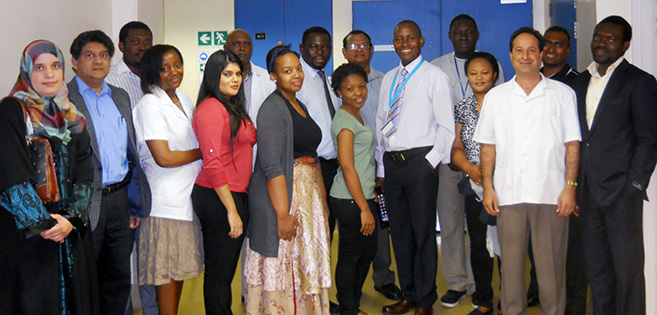 The Discipline of Clinical Anatomy’s Morphology and Andrology Group at a recent seminar.
The Discipline of Clinical Anatomy’s Morphology and Andrology Group (MAG) recently held a stimulating seminar, sharing insights into why current research should address the upsurge of non-communicable diseases (NCDs), especially in sub-Saharan Africa.
The four main types of NCDs are cardiovascular diseases (such as heart attacks and stroke), cancers, chronic respiratory diseases (such as chronic obstructed pulmonary disease and asthma) and diabetes. Recent statistics from the World Health Organization reveal that NCDs kill more than 36 million people each year with nearly 80 percent of these deaths occurring in low-and middle-income countries.
UKZN Senior Lecturer in Clinical Anatomy Dr Onyemaechi Azu said it was alarming that cardiovascular diseases and cancer accounted for 17 million and 7.6 million deaths per annum respectively. Developing countries were most affected.
The global burden of disease was said to be shifting from infectious diseases such as TB and HIV to NCDs, with chronic conditions like cardiovascular diseases (including hypertension and stroke), cancers and diabetes mellitus now being the chief causes of death globally.
Azu said NCDs could be caused by random genetic abnormalities, lifestyle or the environment. Autoimmune diseases, trauma, fractures, mental disorders, malnutrition, poisoning and hormonal conditions are also listed as NCDs. ‘Without action, 52 million people will die each year from NCDs by 2030,’ said Azu.
Research conducted by postgraduate students under MAG is geared to address these concerns, particularly in the light of South African population-based surveys of the early 1990s which show a high prevalence of hypertension and obesity.
With the high prevalence of HIV in countries like South Africa, there is also concern over the fact that highly active antiretroviral therapy (HAART) often have side effects reportedly leading to an increase in NCDs among patients. MAG recognises that cardiovascular complications in HIV-infected populations have not been properly addressed in the advent of HAART and its projects are currently providing experimental models of possible putative mechanisms for this connection and some of the research work has been published in the Journal of Andrology (http://www.ncbi.nlm.nih.gov/pubmed/24919589; http://onlinelibrary.wiley.com/doi/10.2164/jandrol.112.016758/full) and Andologia (http://onlinelibrary.wiley.com/doi/10.1111/and.12233/pdf)
The NCDs – cardiovascular diseases, cancers and diabetes mellitus – have been identified by MAG as a triad of silent killers because they are strongly linked to the prevalence of HIV in the local context.
A myriad of ongoing studies being conducted by MAG covers aspects of structural anatomy and morphometry using latest technology (fluorescence and electron microscopy), PCR and PCR-based
analysis as well as adopting high-end stereological analyses by a cohort of students (Honours to postdoctoral fellows) sharing research insights on the triad.
The discipline continues to host monthly meetings at the University’s Nelson R Mandela School of Medicine campus.
Lunga Memela
author : .author email : .Master’s Student Learns Lab Skills in Denmark
 Ms Colisile Mathonsi.
The months of August and September 2014 have been a life-changing experience for Ms Colisile Mathonsi, a UKZN Master of Medical Science student who received an opportunity to complete the laboratory component of her research at the Statens Serum Institut (SSI), one of Denmark’s largest research institution in the medical field.
The 25-year-old research enthusiast, who holds an Honours degree in Medical Biochemistry, said she could not believe it when she was awarded a grant by the SSI and the College of Health Sciences (CHS) to master laboratory techniques at the SSI which is situated in the city of Copenhagen.
‘My time abroad is helping me to develop my research capacity by learning new techniques,’ she said. ‘I hope to teach those techniques to others when I return to South Africa. I am working with leading international experts and I believe that will have a great influence on my work at home. It is a strong foundation for me as an aspiring medical researcher.’
Mathonsi’s friends and family were happy and excited about her trip. Her research supervisor and Head of UKZN’s Optics and Imaging Unit, Professor Anita Naicker, who conducts ongoing collaborative research on preeclampsia with the SSI, notified her of the grant. Hypertension in pregnancy accounts for 14% of maternal deaths in South Africa and is linked to the development of preeclampsia. Although she had never ventured abroad before, Mathonsi said her fears and anxieties could not hold her back.
‘I have always been a curious individual and during my Bachelor’s degree I studied various subjects including immunology, developmental biology, biostatistics, toxicology and metabolic diseases, all of which made me even more curious and more interested in medical research.’
Mathonsi’s penchant for research intensified during her Honours year when she investigated the effects of Tulbaghia violacea's bulb, stalk and leaf on Madin-Darby Bovine Kidney (MDBK) Cells.
‘I recognised then that medical research is significant in our society because we live in a world where diseases emerge and re-emerge. It is important for medical research to be done so that we can find ways to combat such diseases which are threats to human health. I am passionate about my studies because I love helping people and I strongly believe that a career in medical research will help me make a difference in other people’s lives.’
Mathonsi said she was also passionate about youth development and loves to be involved in community projects that aim to advance young people’s lives. She serves as a mentoring co-ordinator for the Umkhumbane Schools Projects which is sponsored by the KwaZulu-Natal Research Institute for Tuberculosis and HIV (K-RITH) and is focused on helping schools in the Cato Manor region. ‘Together with other mentors we provide guidance to high school learners in areas such as time management, study skills, career planning, and handling peer pressure. I am also a project officer for Driving to Success which is an organisation that helps with youth empowerment.’
Travelling in the efficient public transport system of Copenhagen has been a definite highlight for Mathonsi. She said she loves the cleanliness of the city and meeting people from different backgrounds. She also loves the architecture and how proud locals are about their culture and Danish history.
Mathonsi looks forwards to pursuing part of her PhD abroad and gaining expertise in cutting-edge laboratories, using high-tech equipment and learning techniques that will be of benefit to those she can teach back in South Africa.
Lunga Memela
author : .author email : .Free Hearing Screening for UKZN Community on Deaf Awareness Day
 Final-year Audiology students raise awareness around deafness and hearing loss at Westville campus.
Do you often miss out on conversation? Do you think people are mumbling? Do people complain that you put up the volume too high? Do you struggle to hear people on the phone or even in group conversations? These symptoms should urge you to get your hearing tested.
This was the message relayed by fourth-year Audiology students when they held the discipline’s Annual Deaf Awareness Campaign at the Westville campus as part of Deaf Awareness Month.
The campus Quad was abuzz with staff and students who flocked to the students’ exhibition to collect information and receive a free hearing screening in the Audiology Clinic which offers testing on an ongoing basis. Tests are conducted by Audiology students under the supervision of a qualified Audiologist.
Hearing loss can be caused by exposure to loud music, industrial noise and gun firing. It can also be caused by ear infections, genetics, ototoxic drugs such as medication, ageing and a host of unknown factors.
The Deaf Awareness Campaign alerted the University community to the fact that although it is more common in older people, anyone – from babies to adults – can suffer hearing loss.
A person who is unable to hear some sounds is said to present with hearing loss while a person who is able to hear some sounds is said to be hard of hearing. It is when an individual is unable to hear any sounds at all that they are considered as deaf.
Ms Shannon Magee who was based at the campus Audiology Clinic on the day said they were pleased to see so many people turn up for screening. ‘What we’re doing today is helpful to the University community. It’s also free-of-charge so we’re quite glad to see so many students and staff rocking up.’
Attracting passers-by with the rest of the team at the Quad was Audiology student Mr Mondli Mkhanya who said it was exciting to see such a good turnout. ‘Awareness is going just the way we hoped it would,’ he said.
Mkhanya decided to study Audiology at UKZN because, hailing from a rural village in the Eastern Cape, he felt more could be done to help people with hearing impairment outside of urban areas. It bothered him that people were assumed to be “dumb” just because they had difficulty hearing, and he hopes to make use of the skills and knowledge he acquires at UKZN to help these communities.
Mkhanya said it was important to raise hearing awareness in indigenous languages because this would sensitise otherwise uninformed people about what it means to live with a hearing impairment, the dangers of losing one’s hearing, and it would educate them about understanding and caring for those who had lost their hearing.
Lunga Memela
author : .author email : .Study Could Help to Distinguish Breast TB from Breast Cancer
 Dr Dibuseng Ramaema.
The Principal Radiologist at UKZN, Dr Dibuseng Ramaema, recently raised awareness about the uncommon but prevalent disease of breast tuberculosis (BTB) when she presented a study she conducted as part of her PhD at the College of Health Sciences Research Symposium.
Ramaema argued that obtaining knowledge of how the disease presents in patients could prevent unnecessary invasive procedures and delays in diagnosis. Titled, “Breast tuberculosis: retrospective analysis of 65 patients in a Durban hospital, KwaZulu-Natal”, the study aimed to describe the radiological findings of BTB, including evaluation of current treatment methods.
While the disease is said to be uncommon with nonspecific clinical and radiological findings, Ramaema said it can occur from direct infection of the breast or from the spread of TB from other parts of the body, such as lungs and ribs. She also said HIV appears to have some association to it.
Ramaema said BTB can affect all races. ‘However, our experience reflects our population demographics, with breast tuberculosis seen predominantly in the African and Indian communities.’
Ramaema said that while there is no specific prevention of BTB, the symptoms are variable depending on the disease pattern in the patient. ‘In general if a breast infection does not respond to standard antibiotics, or is associated with large underarms glands, then one should be suspicious of breast TB.’
Ramaema said there have been few reported cases in the literature of concurrent BTB and breast cancer. What makes her passionate about BTB is that it is a treatable condition but there is general lack of awareness of the disease. ‘The clinical signs are always confused with breast cancer.’
She said she hopes her study will generate new information which can help in differentiating BTB from breast cancer.
Lunga Memela
author : .author email : .Occupational Therapy Research Day Showcases Useful Student Research
 Final-year Occupational Therapy students after a day of impressing adjudicators at the Discipline’s Research Day.
The winning project presented by a group of four Honours students at the Discipline of Occupational Therapy’s Annual Research Day will be presented again at the upcoming Young Health Scientists Research Symposium, an interdisciplinary competition held annually by UKZN’s School of Health Sciences.
Ms Dominque de Klerk, Ms Nthabiseng Masekela, Ms Rochelle Romer and Ms Romaana Abdul-Hamid impressed the adjudicators with a study investigating how the physical and social environment of a well-resourced crèche in eThekwini influenced play among children between the ages of three and four years.
The Discipline’s Research Day is an annual academic event which showcases the research expertise and skills of emerging researchers in the field.
The winning four-person study was supervised by Head of Occupational Therapy Professor Kitty Uys together with Ms Deshni Naidoo who lectures in the Discipline.
Naidoo said the study provided valuable insights into factors affecting children’s ability to play. ‘The findings can contribute to planning early childhood development interventions. Furthermore, the study raised the question about using Western development norms for play versus South African norms’.
The study highlighted the influence of the physical and social environment on children’s playfulness. Participants in the study engaged in onlooking and parallel play with limited associative play indicating a delay in the children’s social interaction/social play. Examining the caregiver-child ratio revealed that having too many children under care resulted in missed opportunities when playfulness could have been promoted, and highlighted the need for caregivers to be trained to promote play among children.
Despite having playground objects and equipment, playfulness was not always promoted as participants frequently focused on the objects rather than engaging in social play with each other. The participants received social cues but had difficulty in giving and interpreting cues from other children, which further inhibited their ability to engage in social play. This has implications for the implementation of therapy. The study also highlighted the importance of making adaptations to the playground to promote interaction and social play.
Guest speaker, Dr Mvuselelo Ngoya, a Development Studies Lecturer at UKZN, encouraged students to continue on their path to research excellence and to do so being cognisant that the communities in which research is conducted should also benefit.
Ngoya’s concern was that members of communities that participate in studies often have a negative impression of researchers who perceive them not as knowledge producers but as research subjects. Ngoya emphasised that research should be used as a tool for empowering both researcher and research participants.
The students also presented on a range of other topics including intergenerational perceptions of life in Mariannridge post-gangsterism, and reasons for low employment rates in people with physical disabilities in the eThekwini District.
Ms Kezaih Freimond, a third-year class representative, said her cohort was inspired by the work they saw and looked forward to their Research Day in 2015.
Lunga Memela
author : .author email : .Final-Year Students Present Stimulating Studies at Undergraduate Research Day
 The winning groups at the Audiology and Speech-Language Pathology Research Day.
The Disciplines of Audiology and Speech-Language Pathology recently held their Annual Research Day during which final-year students impressed adjudicators with an array of topical research projects.
UKZN’s Senate Chamber swelled with academics, student presenters, as well as their friends and family who came to support the successful event.
The guest speaker was Dr Nthabiseng Motsemme, UKZN’s Director of Postgraduate and Research Capacity Development who has also held positions at the University of South Africa Research Directorate and the Wits Institute for Social and Economic Research (WISER), among others.
Motsemme said undergraduate research was showing exciting developments in the College of Health Sciences in line with global trends. ‘The cohort of student presenters is ideal for establishing a foundation for research and building a research culture in their respective fields,’ she observed.
Motsemme spoke about the emerging global knowledge-based economy, which South Africa is also competing in, and which is marked by a constant need for high-level skills. By reflecting on her personal journey as a researcher, Motsemme encouraged the students to excel as next generation innovators. She said it was important for students to dedicate themselves to research projects as this would help to develop their skills in addition to enhancing their CVs.
Supervised by Audiology Lecturer, Ms Samantha Govender, students Ms Nabeela Latiff, Ms Nusaiba Asmal, Ms Sadksha Ramsaroop and Ms Thumeka Mbhele presented the winning presentation: ‘The outcomes of a hearing screening programme conducted on Grade one learners at schools within the Durban central region.’
According to the researchers, the World Health Organization estimates that there are approximately 32 million children globally who present with a disabling hearing loss. They argued that screening programmes for children are essential in deducing prevalence, patterns, as well as identifying risk factors of hearing loss given that the South African Hearing Institute estimates that approximately 7.5% of school children present with hearing loss.
This study also confirmed that school-aged children do present with common ear problems, namely cerumen impaction, middle ear pathologies and possible hearing loss. It found that there are possible gender effects related to the presence of auditory pathology. However, more research was required.
Winners in the Speech-Language Pathology group, Ms Sasha-Lee Wulfsohn and Ms Raihaana Suliman, were supervised by Speech-Language Pathology Lecturer, Ms Saira Karrim. Their study was titled, “Types of feeding problems, food preference and the relationship to family eating preference in children with Autism Spectrum Disorder in South Africa.”
The researchers identified that parents of children with Autism Spectrum Disorder (ASD) face many challenges on a daily basis because eating has an essential psychosocial function in forming relationships with primary caregivers and forming part of a wider social interaction. They presented preliminary results on each study objective as data collection had just begun pending approval from some independent associations for autism.
The study found that children with ASD in South Africa present with typical feeding problems and eating preferences found in children with ASD. ‘These problems have a significant effect on family life,’ said the researchers, unpacking clinical implications, including raising awareness and training programmes for professionals and parents regarding the management of feeding problems. There was also a need to consider foods consumed by various cultural groups in the assessment and treatment of feeding problems, as well as to promote feeding as an area of equal importance to communication.
The winning teams will present their work at the School’s Young Health Scientists Research Symposium 2014 in October.
All final-year students were lauded by academic leaders Dr Penelope Flack (Speech-Language Pathology) and Dr Neethie Joseph (Audiology) for the quality of the work presented and were encouraged to pursue master’s and PhD qualifications at UKZN.
Lunga Memela
author : .author email : .UKZN’s Physiology Students Stake Their Claim at International Conference
 International and local delegates at the 42nd Annual Conference of the Physiology Society of Southern Africa (PSSA) held at the Gateway Hotel.
UKZN’s School of Laboratory Medicine and Medical Sciences students made substantial contributions on the first day of the 42nd Annual Conference of the Physiology Society of Southern Africa (PSSA) which had as its theme: “Physiology in Southern Africa: taking back the centre stage of human life sciences.”
Ms H Sibiya’s impressive study titled, “Evaluation of the efficacy of transdermal delivery of chloroquine on Plasmodium berghei-infected male Sprague-Dawley rats: effects on blood glucose and renal electrolyte handling,” generated a keen interest amongst the International and local delegates attending the session at Gateway Hotel, north of Durban.
The study investigated whether chloroquine (CHQ) delivered transdermally can reduce malaria parasites and avert the reported adverse effects associated with oral CHQ.
According to Sibiya, oral administration of CHQ evokes adverse effects on glucose homeostasis and kidney function in African children, probably due to high plasma CHQ concentrations.
She said studies indicate that oral administration of amidated-pectin chloroquine beads formulation sustains controlled release of CHQ into the bloodstream.
‘Accordingly, we speculated that CHQ, administered via amidated CHQ-pectin patch, sustains controlled release of CHQ into the bloodstream,’ she said.
She said the pectin-CHQ patch was prepared using a protocol previously described with slight modifications. Parasitaemia, blood glucose and renal function were monitored in groups of non-infected and Plasmodium berghei-infected male Sprague-Dawley rats following twice daily oral (30 mg/kg) or a once-off transdermal delivery (53 mg/kg) of CHQ.
Sibiya said these parameters were monitored over a 21-day period divided into pre-treatment, treatment and post-treatment. Transdermal delivery of CHQ and oral CHQ equally reduced P. berghei parasites to undetectable levels by day five of treatment.
She said oral CHQ significantly decreased blood glucose concentrations of both non-infected and infected animals.
‘Interestingly, the once-off topical application of the pectin-CHQ patch increased blood glucose concentrations of P. berghei-infected animals. ‘Furthermore, oral CHQ treatment was associated with increased urinary Na+ outputs and hyperkalaemia in both non-infected and infected rats. The CHQ patch did not influence these parameters.’
She said the study concluded that transdermal CHQ delivery not only delivers CHQ into the systemic circulation, but has the potential to ameliorate the pathophysiological effects associated with oral CHQ treatment.
UKZN student, Ms Rivona Harricharan, was awarded a Special Commendation on the second day of the Conference for her presentation titled “Tat-induced histologic alterations mediates hippocampus-associated behavioural impairments.”
The aim of her study was to provide insight into the fundamental behavioural and histopathological mechanisms underlying the development and progression of HIV-1 neuropathology.
According to Harricharan, the novel study directly highlights the correlation between hippocampal-associated behavioural changes with histologic alterations following stereotaxic intra-hippocampal administration of Tat protein in rats.
She said the implications of this study may positively impact the fields of immunology and neuroscience by encouraging future researchers to consider novel strategies to understand the complexities of HIV-mediated dementia pathogenesis.
UKZN Physiology Professor Mahendra Channa said the Discipline of Physiology needs to extend the participation of young members, hence the Conference theme – “Taking back the centre stage of human life sciences”.
Channa welcomed all delegates, saying his Discipline was proud to host the Conference which drew participants from almost all South African universities as well as those from Namibia, Botswana, Zambia and Nigeria. They ranged from new researchers taking tentative steps at their first research forum to internationally-rated researchers who lead the way in their respective fields.
‘In keeping with one of the strategic initiatives of the PSSA, we have arranged a Young Physiologists Session to follow up on the one last year. We urgently need to expand the participation of our younger members in the affairs of the PSSA,’ he said
He said much introspection, debate and discussion is required pertaining to the future role of Physiology at tertiary institutions, hence the theme for this year’s congress.
In his opening address, PSSA President, Professor Faadiel Essop, said: ‘Our Discipline has had to take something of a back seat during the last few decades. This may be attributed to two significant developments over the last few decades, namely, molecular biology (the post-DNA helix discovery) and the “omics” eras. Although the latter includes invaluable techniques such as genomics, proteomics and metabolomics, these two “waves” of developments have unfortunately contributed to Physiologists and physiology as a discipline being increasingly marginalised.’
He said Physiology departments have gradually disappeared, now typically forming part of larger, amalgamated departments. ‘This of course has in some instances resulted in a sense of lost identity and also a feeling of isolation. This meeting is, however, part of a process of moving Physiology back into the spotlight,’ he added.
According to Essop the meeting provided an ideal setting for Physiologists to stake their claim and showcase how they can help integrate information and thereby help advance knowledge creation within the human life sciences discipline.
Nombuso Dlamini
author : .author email : .Local Government Expert Appointed to Board of Flagship Professional Journal
 Professor Purshottama Reddy.
Local government specialist Professor Purshottama Reddy has been appointed to serve on the Board of the most-read public administration professional journal in the world.
For the next three years Reddy will be making a contribution to global public administration knowledge as a member of the board of editors of Public Administration Review (PAR), the flagship journal of the American Society for Public Administration (ASPA).
Reddy said he is honoured to be nominated to serve on the Board and is looking forward to contributing his knowledge, to exchanging information, and working alongside international experts in the field.
‘The success of Public Administration Review owes much to the hard work and commitment of its distinguished board of editors. The status of PAR as the premier professional journal in public administration is due, in part, to the thoughtful and constructive evaluation of manuscripts by members of the board of editors,’ said PAR Editor-in-Chief Professor James L Perry.
Members of the PAR board are expected to uphold the values and principles of ASPA in general and PAR in particular, review manuscripts in a timely manner, and serve on committees as assigned by the editor-in-chief. It is also an expectation that members of the board are ASPA members.
UKZNDabaOnline
author : .author email : .The UKZN Griot. Of Left and Right
 .
Keyan G Tomaselli*
I am often asked, ‘What is cultural studies?’ The phrase sounds like a goof-off touchy-feely set of silly creative practices conducted by arty-farty academics pretending to be culturally relevant. Those who have read into bona fide cultural studies know otherwise, that it developed a highly rigorous and daunting philosophical interrogation of a variety of disciplines in establishing its body of knowledge derived from the study of ways of life in conflict. The outcome was to change the way that the humanities and some social sciences go about their business.
June 2014 saw the end of an era at the University of Birmingham (BU) where the Centre for Contemporary Cultural Studies (CCCS) originated in 1964, but where it was opportunistically terminated in 2002, with a reoccupation from 2014 as a successor generation tried to recover and codify the Centre’s global impact in an archive, exhibition and conference. These events followed shortly after Stuart Hall’s death. Jamaican-born Hall was the Acting Director for many years and it was under his leadership that most of the top British cultural and media studies scholars graduated. This event was simultaneously conference, tribute and wake, not just in memory of Hall but also the memory of what should be. Hall-the-ancestor was with us all the way, in video, in concepts, in eulogies, in a space that had always been hostile to the Centre and its critique of Thatcherism, and its concern with popular culture and working class issues, read through history.
It quickly became clear what BU had squandered: a global cultural studies (CS) intelligentsia catalyzed by the Centre, successive cohorts of media studies scholars who established the paradigm, community activists who took resistance strategies they had learned at the Centre to the streets and communities, and a unique publishing project and interdisciplinary analyses that anticipated the rise of the neoliberalism wrecking ball where outputs are ranked over inputs; game-changing paradigm shift is eschewed over conveyer belt research, and where creativity, innovation and conceptual risk-taking are now discouraged.
Three themes emerged as historically constituting the CCCS project: a) how academics could work as organic intellectuals in exposing anti-democratic tendencies, b) how to create the New Left (opposing anti-humanist Stalinism and critically interrogating capitalism), and c) cultural studies offered the ‘critical cut that cannot be healed, creating a critical ruin that cannot be reassembled’, observed Iain Chambers, a graduate of the Centre. Pervasive and repressive hegemonies – within and without the academy – would be contested, fractured and exposed, and then replaced with democratic bodies of practice. CS was once a globally collaborative and uniquely energetic space; now, it is largely an undergraduate teaching programme sometimes celebrating, but more usually studying, consumptive aspects of neoliberalism. It has been tamed. Porn Studies, Celebrity Studies, Consumer Culture, and a whole slew of titles on fashion studies, are just some of the new journals that feed the field, often critically it needs to be stated, though many students and their lecturers often, ironically, interpret these critiques as technical manuals enabling their successful entry into neoliberal enterprise.
What has been exposed, thus, is the failure of cultural studies to stem the repressive tide of the kind of unfettered and unregulated neoliberalism whose banking interests nearly destroyed the global economy after 2007. No other field has ever imagined itself as a player in the winning or losing of struggles, as did the Birmingham trajectory and its diasporic variants. Few disciplines take sides, though all do, whether admitted or not. Where some journals do retain the critical cut, the classroom has lost the sharpness, and while tertiary management tolerates abstract political economic critique, it is often intolerant of questions that address the systems and assumptions that manage the contemporary neoliberal academy.
Where the Birmingham Centre was always an unrealised asset at its home institution, CCMS research directions always have had the support of top management here. Where CCCS was on the losing side, CCMS was on the winning side, just until the win was turned into a loss by willful regression into elitist hegemony. CS was part of the South African policy moment of the 1990s: cultural, media, education, and health promotion. UKZN staff and students contributed white papers, strategy documents, policy generation and all manner of initiatives, as did others from elsewhere. But the New Left lost its way, talking left but walking right as Patrick Bond has observed.
The New new left comes and goes, but occupations of Wall Street, protests against the World Cup as the greatest exploitative neoliberal roadshow ever, fail, but keep dissent bubbling. If capital can survive the banking meltdown, and with state connivance still reward the thieving perpetrators for their utter failure and dishonesty, the failure itself becomes lauded as legitimate success. Processes are turned inside-out - all that’s sold melts into air. That’s the contradiction that still needs to be examined (with apologies to Karl Marx).
The conference marked the closure of a heady, never-to-be-repeated era, one that began 50 years ago. At its wake where its ageing CS apostles met, joked, and commiserated with each other, the warmth and collegiality was extraordinary, one borne from a common project that had started in England but which also arose out of Frankfurt School sociologies of Nazism. Out of this last collective gasp emerged the CCCS Archive, a living index to what could have been, hosted by the University that had thought it had laid CCCS to rest. Yet, the cessation of the Centre at Birmingham in 2002 could not impede CS’s growth elsewhere or, indeed, its “pop-up” reinsertion into its old nemesis, as Richard Johnson kep telling delegates. This is the dialectic at work.
Cutting critical thought remains the raison d’être of the academy – though it may take on new forms. Back home, many old organic intellectuals who fought apartheid from the trenches however are now the self-enriched technical intellectuals of the new elitism, though many others are now again popping up as the new organic intellectuals in the post-apartheid era interrogating the new hegemonies. The generation replacing us battered old timers (the once-were-warriors) was present but largely silent: for many of them CS is a syllabus, not revolt, philosophy or reconstruction; for them no new order is even imaginable under current circumstances, though two youngsters from the periphery did interject with appeals about the need to decolonize theory.
All in all, here at UKZN CCMS and many others in many disciplines have been part of a global era and intellectual movement that may be never again repeated. This column is thus testimony to the vision of the staff-student committee whose ceaseless work arising out of the smoke of Soweto ’76 put in place a project that endured well into the post-apartheid era. As my colleague Lauren Dyll-Myklebust observed on reading the draft of this column, ‘We need to find and “train” (in CCMS) the new warriors that can grapple with society today.’
*Keyan G Tomaselli was a speaker at the CCCS50 conference, where he regaled colleagues about life in the trenches and how CS enabled a new democracy to emerge.
Disclaimer: The views expressed in this column are the author’s own.author : .author email : .Nokuthela Dube Remembered at Memorial Lecture
 From left: Professor Johannes Smit, Dean: School of Religion Philosophy and Classics (SRPC); Professor Raymond Kumalo (SRPC); Dr Sibongiseni Dhlomo; Professor Cheryl Potgieter; Dr Gcina Mhlophe; Professor Gregory Kamwendo, Dean, School of Education; Ms Judaline Mulqueeny, eThekwnini Municipality; and Professor Renuka Vithal, DVC for Teaching and Learning.
As South Africa celebrates and reflects on 20 years of freedom and democracy, this year’s annual John Langalibalele Dube Memorial Lecture organised by the College of Humanities highlighted the contributions and significant strides made by women in the fight for liberation.
Guest speaker, Dr Gcina Mhlophe, paid homage to and drew from the educational and activist legacy of Nokuthela Dube, the first wife of John Langalibalele Dube.
Mhlophe, an activist, actor, storyteller and poet, delivered her Lecture in both isiZulu and English. The talk was titled: "Writing women, gendering history: what would it mean to look at the 20th anniversary of South Africa’s democracy from the perspective of Nokuthela Dube?"
Deputy Vice-Chancellor and Head of the College of Humanities Professor Cheryl Potgieter welcomed Mhlophe and other esteemed guests who included KZN Health MEC Dr Sibongiseni Dhlomo and the families of both John and Nokuthela Dube.
‘We recognise Nokuthela as a leader, educator, woman and artist in her own right and we honour her contribution to the democracy of South Africa. She represents a generation of South African women and its unsung heroines. As the College of Humanities, we hope to have a series of lectures in the future to acknowledge women leaders like Nokuthela,’ said Potgieter.
With her trademark storytelling flair, Mhlophe entertained the audience with poetry and great anecdotes pertaining to Nokuthela. However, Mhlophe noted that almost 100 years since Nokuthela’s death, very few people knew that she even existed.
‘Why on earth did our history choose to forget this diamond of a woman? Or would it have been better if she had been a man? History needs to sometimes be called HERSTORY too. Otherwise many more women who fought for a better South Africa will be forgotten.’
Mhlophe made reference to journalist and author Bessie Head and Head’s hopes for the future of the country. She went on to engage the audience by calling out names of other women activists who should be remembered, such as Lilian Ngoyi, Fatima Meer, Ruth First and Miriam Makeba.
‘So many people were impacted by Nokuthela’s work,’ she continued. ‘The time has come for us to finally shine a spotlight on her name so that many more will stand up and find ways to celebrate her life. In different artistic expressions, we need to relearn how to not be intimidated by sexism, racism, patriarchy and other chains that continue to tie down African women to this day.’
Mhlophe shared her horror at the brutality and violence still being committed against women, even as the country celebrated Women’s Month in August. ‘The countless freedom fighters who laid down their lives for us must have dreamt of a more balanced and caring nation than this.’
In response to Mhlophe’s lamentation, KZN Health MEC Dr Sibongiseni Dhlomo said that men must take a stand against violence to women. ‘My theory is that if the world is led by women we might see fewer wars, less killings and the spreading of love. We must give respect to women; in light of all that Nokuthela Dube and other great women have done, we must give respect to women: past, present and future.’
Mhlophe also raised the importance of quality education. ‘Arts and education are twins that should never be separated. Our nation would be better off with more focus being given to creative spirits like Nokuthela in joining hands with educationists to build successful young South Africans.’
As a token of appreciation for and in recognition of the efforts of Nokuthela Dube, framed photographs of both John and Nokuthela Dube were handed over to their respective families and to the school principals of the Incwadi and Ejubane schools which were founded by Nokuthela and John Dube in the mid-1890s.
Melissa Mungroo
author : .author email : .info4africa and Always Active Launch Health Information App
 Ms Debbie Heustice (extreme left) Mr Alan Haarhoff (fourth left) with high school learners from the Durban Youth Council at the launch of the info4africa mobile application at the BAT Centre.
info4africa, the national health and wellbeing referral network and self-funded centre within the School of Applied Human Sciences, has added an Android app to its bouquet of services, making the finding of health and wellbeing service providers in South Africa that much simpler.
Developed at a Geekulcha hackathon held in June, a small development team, headed up by Diamond Mubaarak, created the application. Always Active Technologies (AAT), a mobile and database development partner to info4africa, submitted the idea for the hackathon challenge, providing the developers with an application programming interface (API) to info4africa’s database, which the company develops and manages.
Unveiling the app at a meeting of the Durban Youth Council recently, info4africa Director Ms Debbie Heustice said: ‘Our motivation for collecting and collating health and wellbeing service provider information, and making it easily accessible for all South Africans continues unabated.
‘We’re proud to release our info4africa mobile application and look forward to making it even easier for everyone to access our referral network database from wherever they are. Our thanks go to our technology partner, Always Active Technologies, for supervising this development and helping us move forward with our mobile technology programmes.’
Mr Mixo Ngoveni, Founder of Geekulcha said: ‘Seeing the info4africa app come to life brings us great joy, especially because it was submitted as one of the challenges at the Geekulcha “Make Life Easy” Hackathon. The development of this app demonstrates how the incredible talent in South Africa can make a difference to every citizen’s life.’
The Android app, now available on the Google Play Store, enables users to search for their nearest health and wellbeing service provider, using either GPS triangulation on their mobile device or by manually inputting their address or chosen location.
Once users have found what they’re looking for, they can simply long press the provider name and their mobile handset will call the telephone number listed. If users would prefer not to make a call, and rather visit the service provider, they are presented with a nifty map, which will direct them.
info4africa has a long history of collecting and collating service provider information, and is a well-recognised source of reliable information in both private and public sectors. Its referral network database houses comprehensive information on more than 12 000 health, wellbeing and development organisations across the country, and each entry is carefully captured and updated on an annual basis.
AAT’s close partnership with info4africa has borne great fruit over the years. AAT provides mobile and database technology services to the referral network centre, and they’ve worked together to create unique opportunities for all South Africans to get the health information they need, wherever they are and no matter what mobile handset they use.
Mr Alan Haarhoff, Business Development Manager at AAT, said: ‘This is a really exciting step for us. Over the years the dissemination of info4africa’s information has evolved to include various channels – the print directory, the USSD service, the Mobi site and now an Android app.
‘The fact that a South African tech start-up developed the app is no coincidence for us. As South Africans we need to find solutions to our unique problems, and what better way than through the team work of an NPO, a tech start-up and an established mobile agency.’
As an information provider, info4africa is committed to making their referral network database information available to and accessible for all South Africans. The database can also be searched using a USSD mobile phone directory (dial *120 *448# from your mobile phone); a mobisite (info4africa.storefind.mobi) and an SMS service (Send an SMS to 45080). Download on Google Play Store: http://bit.ly/i4a_Android
Melissa Mungroo
author : .author email : .A New Era for Education
 School of Education academic Dr Siphiwe Mthiyane.
It’s a dreary Thursday morning. The skies have blackened but the rain has held off so far. I am about to meet Dr Siphiwe Mthiyane, a Lecturer in the School of Education at the Edgewood campus in Pinetown. I’m running a little late, due to a truck-filled N3, worried that the former school principal will give me a lashing for my tardiness. But to my surprise, he envelopes me with warmth, flashing a smile that erases any worry.
When we finally start chatting, I realise that it has been a busy year for Mthiyane. He graduated this year with a Doctor of Philosophy degree, supervised seven students who also graduated this year and published more than five academic papers with colleagues. Currently, he is involved in a number of research projects and he also visits high schools regularly to motivate Grade 12 learners ahead of their daunting end-of-year exams.
How does he do it all?
‘You just have to focus,’ he said. ‘You have to be dedicated in what you do. I tell my students that you have to have a goal and once you have that goal, you have to be dedicated to see it through.
‘I also work with very supportive colleagues. Through their motivation one had no choice but to do one’s work in order to get this [PhD] done. I was never under pressure to do a PhD because the University wanted me to do it … I did it because I wanted to.’
Much of the work for Mthiyane’s thesis, titled “Dynamics of school-based violence: exploring school governing bodies in addressing school violence in post-conflict South African schools” was completed last year.
‘I had finished most of the work on my thesis last year but I realised that I couldn’t submit for last year’s graduation. So I did the final touches and waited for examiner reports to come back and I graduated this year,’ he said.
Together with Professor Vitallis Chikoko and Dr Inba Naicker, he is conducting research on school leadership development. The School of Education has a programme called the Advanced Certificate in Education - School Leadership (ACE-SL) aimed at developing serving principals, heads of department and other aspiring school leaders.
‘As researchers we saw this as an opportunity … All over the world there is a feeling that if you develop the leadership of the school, chances are this will rub off on the manner in which the teachers lead, manage and teach the learners in the classroom.
‘We have a new South Africa with new ways of doing things. We are coming from an oppressive, racist and sexist past. We are now moving into a new era of democracy where even the manner in which we lead, govern and manage our schools has to change. That is what we are teaching our students: the new ways of leading and managing schools which are in line with our Constitution,’ he explained.
Another project Mthiyane is working on is in the area of school decline, school choice and learner demographic changes or migration in desegregated schools in Durban.
‘If you go to township schools, you will still not find White, Coloured or Indian children there, even though officially there is no rule or law which says they cannot attend those schools. I’m not aware of any schools in the townships which has attracted other races. What has happened is that the road has been one-way. Africans are moving to former Coloured, Indian or White schools. But we are also observing that when African, Coloured and Indian learners enrol at these schools, the White learners tend to dwindle. In the community there are still White learners, but they are not attending local schools.’
As part of the research, teachers and principals have been interviewed on their opinions of this phenomenon. ‘Perhaps if we have access to parents later on, we will also want to find out from them where they are sending their children and why are they not sending them to the schools that they themselves attended.
‘It is very interesting because you still find that these schools have largely White principals and teachers, but the majority, if not all the learners, are Black (African, Indian and Coloured). Why are staffrooms not changing in line with the learner demographics? That is what I am researching.
‘What I am finding is that a number of wealthy Indians and Whites are removing their children from these schools into private schools. Is it because of issues of education quality or is it because of issues of class or racism? We don’t know, hence the need for this research.’
The research will be published early next year, according to Mthiyane.
Before joining UKZN in 2009, Mthiyane was a principal at a school in Inanda for 10 years and he feels strongly about regularly visiting high schools to motivate Grade 12 learners.
‘I go to schools on invitation and I address mainly Grade 12s. I talk to them about a host of things that young people may need to know, especially about graduating from high school to university and the demands of a university. But I also motivate them before they write their trials or end-of-year exams,’ he said.
As someone who always strives for excellence, Mthiyane believes that one needs to work hard to achieve one’s goals. ‘I’m not sure if I’ve achieved success, but its hard work, sacrifice, planning and commitment. The reverse is also true: lack of commitment, discipline and persistence are major causes of failure. I share these ideas with students whenever I am afforded an opportunity.’
Xoliswa Zulu
author : .author email : .Applied Ethnomusicology Students Present Heritage Month Concert
 African Music and Dance (AMD) students perform on stage to songs and dances derived from the Royal Reed Festival.
Two honours students from the Public Sector Applied Ethnomusicology and Community Development module in the Music Discipline recently presented a lunch-hour concert at the Howard College Theatre based on their respective research fieldwork.
In their respective research projects, the students, Ms Thabile Buthelezi and Ms Nontobeko Sibiya, looked at the Royal Reed Dance ceremony in Swaziland and Nongoma and the shifting role of Zion music in different settings such as academic institutions, churches and the entertainment industry.
The students worked together to produce an edu-concert to coincide with Heritage Month, bringing culture and heritage to life through their selected dance and musical performances, which included a cultural parade from the E G Malherbe Library to the Howard College Theatre.
‘The parade was an interpretation of the Reed Dance ceremony in Swaziland and Nongoma when maidens proceed to hand over the reeds to the king, and in celebration they dance and sing on their way to the arena. The Reed Dance encourages young girls not to engage in sexual activities while also teaching them to respect themselves and be leaders of their homestead,’ said Buthelezi.
Through her performance action research, Buthelezi hopes to encourage young girls to participate in the cultural initiative and to educate others on the procedures, culture and beauty of the Reed Dance ceremony.
Her showcase featured songs and dances derived from the royal festival Amahubo Omkhosi Womhlanga with a special interpretation of the dance done by Swaziland’s Princess Sikhanyiso Dlamini.
An exciting adaptation of Zion music was also showcased with singers hailing from the Association for Tertiary Zion Students (ATEZ) performing repertoires from their CD. A singing arrangement was performed on stage to illustrate the differences between Zion and Gospel music.
Both students thanked their teams of dancers and performers along with the School of Arts and Dr Patricia Opondo of the Music Discipline.
Melissa Mungroo
author : .author email : .