Overcoming Great Obstacles to Graduate with a PhD in Education
 Dr Anita Hiralaal graduates with her PhD in Education.
Durban University of Technology Accounting lecturer Dr Anita Hiralaal, was all smiles when she was awarded her PhD in Education (Teacher Development Studies) from the University of KwaZulu-Natal.
Hiralaal overcame great obstacles to graduate. During her time as a doctoral student, she experienced major life challenges. In 2011, she suffered the loss of her husband and two years later she suffered a stroke which affected her eyesight and co-ordination.
‘Due to the stroke, I spent some time in hospital as I needed intense treatment. My sabbatical leave was spent getting occupational therapy, physiotherapy and psychological counselling because the stroke left me with severe depression. In this time, I still had to manage my late husband’s business and my household.
‘It was a very difficult time in my life, nevertheless I had to be brave and I realised that I had an inner strength that kept me optimistic and courageous,’ said Hiralaal.
However, despite these challenges, she worked extremely hard and devoted a great deal of time and effort to her research and writing that earned her a PhD.
Hiralaal strives towards becoming a more productive role model to her students. Firstly she had to establish what moulded her and shaped her professional development into becoming an Accounting teacher.
‘I chose the topic A Self-Study of My Role Modelling as a Teacher Educator of Accounting Pedagogy because I wanted to explore my lived experiences and establish how these experiences impacted on my development because I believe that not only does the past influence the present but it also plays a huge role in the future,’ she explained.
Hiralaal used her favourite childhood novel, The Secret Garden by Frances Hodgson Burnett as a creative non-fiction device in constructing her thesis. She fashioned the fictional life experiences of the protagonist against her lived experiences, giving her doctoral journey a magic-like quality.
‘What was most enjoyable for me was adopting an arts based self-study approach. I am not an artistic person but I was able to construct collage portraits and found poems. I began incorporating the arts into my daily teaching activities and the response from my students was phenomenal.
‘It made me realise that I do not have to draw or paint like an artist or produce some fantastic artistic creation, I just had to use whatever resources I possessed personally and with a little bit of effort and thought, I could be just as creative and innovative as any artist,’ explained Hiralaal.
She gave her students the freedom to learn and in doing so, she feels she was freed. ‘Freed from narrow constricted educational values to challenging, wide, innovative and exciting educational values. Not only did my pedagogic practice improve, but I was transformed as a person.’
She thanked her supervisor Professor Kathleen Pithouse-Morgan, family and friends. Pithouse-Morgan said she was impressed by Anita’s perseverance and unwavering determination to complete the thesis.
‘Anita was also a pleasure to supervise because of her creativity, her openness to new ideas, her passion for her study, and her commitment to improving her role modelling as a university educator.’
Some of the comments to her examination reports were: ‘It was a pleasure to read and examine this thesis which offered a refreshing alternative to the traditional form of academic research report. The findings have tremendous value for other educators of any subject who wish to improve their own pedagogy. I think this is an excellent example of a self-study and one of the most enjoyable theses I have read in a long time.’
While another said, ‘This thesis is a credit to the University of KwaZulu-Natal and provides evidence that the knowledge-bases of the self-study, transformative educational research, and Living Theory research that are being supported by the University are at the international forefront.’
Words: Melissa Mungroo
author : .author email : .Mauritius PhD Cohort Student Graduates at UKZN
 Dr Avinash Oojorah graduated from the University of KwaZulu-Natal with a PhD in Education.
Mauritian Dr Avinash Oojorah graduated from the University of KwaZulu-Natal (UKZN) with a PhD in Education. He is part of a programme which started after the signing of a 2011 Memorandum of Understanding (MOU) between the Mauritius Institute of Education (MIE) and the School of Education.
The programme supports candidates through a site-based supervision cohort model using supervisors from South Africa and Mauritius. The PhD students, largely staff members of the MIE, research areas of innovation and development within teacher education on the island.
Oojorah’s research was an autoethnography that looked at design principles used to digitise the primary school curriculum at the MIE. He drew from his personal and social experiences, his journey in academia, at the MIE and around the world and how it related to the specific field of digitisation of curriculum.
‘I have been leading a team of innovative minds who have been at the forefront of ICT integration projects in Mauritius. Over the years we have striven to provide teachers and learners with digital learning resources. We also devised and implemented training and empowerment for numerous stakeholders in education and provided support to end users of technology in the classroom.
Oojorah said his study explained what influenced his choices regarding design principles, adding that it was heavily influenced by the post-colonial context. ‘Mauritius was a former colony of European powers and all socially constructed visions that colonised and displaced people. It deals with neo-colonialist schemes such as digital neo-colonialism. I think my research could be quite useful in this regard as Mauritius is celebrating 50 years of independence this year.’
At a societal level, Oojorah believes his research could help other people in the post-colonial context to resist digital neo-colonialism. ‘With some effort, one can change from a taker of technology to a maker of technology. People give meaning to technology not the other way round.
On a more practical level, my research provides answers to those who want to engage in curriculum digitisation. My study proposes models and strategies for ICT integration and design principles to digitise the curriculum.’
Oojorah thanked his family, friends and supervisors for their support.
He advised other researchers going for their PhD to be physically fit, saying it is gruelling, but that they should go for it. ‘You will make mistakes, but you will also grow with these mistakes. You need to talk and talk and talk about your research. If you find people willing to listen to you, you’re going to make it.’
Oojorah plans to continue researching and one day publish a book based on his PhD study.
Words: Melissa Mungroo
author : .author email : .Mother and Son Graduate with Degrees from UKZN
 Dr Loretta Mkhonta and her son Mr Sizwe Hlophe graduate together from UKZN.
Mother and son, Dr Loretta Mkhonta and Mr Sizwe Hlophe graduated at the University of KwaZulu-Natal’s recent Graduation ceremonies. Mkhonta, who obtained a PhD in Education, and Hlophe who achieved a Bachelor of Social Sciences, were both ecstatic to be sharing the moment together, each dedicating their degree to the other.
Loretta, director of an international childcare non-government organisation in Swaziland, wept tears of joy and pride when her son received his results. ‘I am a very happy parent right now. It was a long and difficult road for Hlophe to get to this point. It has been an exciting time for our family because we were preparing for two graduations. It has been surreal. The joy of finishing this long journey is indescribable.’
Hlophe said he was honoured and blessed to graduate in the same year as his mother. ‘Despite my mom’s tight budget, she never complained about the cost of my education. I know how much she sacrificed for me. I thank her for the values she instilled in me, especially perseverance and honesty. I would not be who I am today without her commitment and support.’
Mkhonta, who is passionate about helping orphaned and vulnerable children, based her PhD research on the reasons behind secondary learner dropout from a child rights perspective.
She found teenage pregnancy to be one of the reasons for the high drop-out rate in secondary schools. ‘Learners, especially those who face adversity daily in their lives have unique schooling experiences that force them to leave school. Factors such as corporal punishment, stigmatisation, and painful living conditions at home can force them to leave school.
Duty bearers are directed by policies on how to assist learners to stay in school but that does not translate into practice. Schools, families and communities have a role to play to help learners stay in school but they do not have the capacity to intervene. Retaining learners in school needs a multi-sectoral and multi-disciplinary approach,’ explained Mkhonta.
Her greatest challenge was balancing work and her studies. ‘In my previous job I travelled frequently throughout Africa. There were times when I was in places that did not have access to the internet. I could not reach my supervisor or meet deadlines. However, I started valuing the travels because it was when I got most of my work done. My travels opened up my perspectives on the topic. My current job is demanding of my time. I have not had a free weekend for ages.’
Loretta will be taking a well deserved holiday in Europe in August. ‘I want to publish two research papers on my work experience with orphaned and vulnerable children. Eventually I would like to go back to being a teacher trainer at our local university.’
Adjusting to life away from home, lecture-style classes, and unfamiliar grading schemes were some of the challenges Hlophe faced. But he never gave up and ensured he graduated.
‘I have learned to treat a “F.A.I.L.” as my “First Attempt In Learning” because I believe in second chances and the opportunity to strive for better. Throughout my undergrad, the uncertainty of the future caused me a lot of stress and concern. As much as I valued living in the moment and enjoying my time as a student, the need to figure out postgrad plans was always looming in the back of my mind.
‘Luckily, I stayed strong for most of the year, focusing on school and finding relevant extracurricular activities. I realised that I have my entire life ahead of me to figure out the future. Although it is important to be forward-looking, the end of a three-year undergraduate programme is by no means a deadline for finding full-time employment or applying to a graduate programme. It is the beginning of an exciting future,’ said Hlophe.
Words: Melissa Mungroo
author : .author email : .PhD Graduate’s Research Explores Teachers and the Work They Do
 Dr Nomkhosi Nzimande graduates with her PhD in Education.
University of KwaZulu-Natal staffer Dr Nomkhosi Nzimande graduated with a PhD in Education for research that explored the work done by teachers. Her study delved into teacher professionalism, intensification of teachers’ work and teacher stress.
Her intention was to explore, not only teachers’ but also parents’ everyday talk (rhetoric). ‘It looked at namely their conceptions, beliefs and taken-for-granted understandings about teachers’ work.’
Juxtaposing teachers’ rhetoric with parents’ rhetoric in Nzimande’s study revealed their points of similarities, differences and tensions. Her analysis enhanced the understanding of teachers’ work, moving it beyond parents’ and teachers’ beliefs. The analysis shifted from an interpretive lens (dialogic nature of a discourse) to a poststructural lens (contingency nature of a discourse). Her study posits that the rhetoric is a class-based perspective.
‘The rhetoric of parents (who come from low socio-economic class) showed that, despite their disillusionment about the negative attributes of teachers (such as laziness and unprofessional behaviour) parents are sympathetic towards teachers. Parents from the low socio-economic background are sympathetic because they understand the plight of teachers who have to work with ill-disciplined learners, and sometimes under unbearable conditions of work.
While middle class teachers feel they are not supported by the Department of Education, parents and school management. As a result teachers feel powerless to challenge some of the departmental policies they are expected to enact,’ explained Nzimande.
She suggested that a multi-layered support would be beneficial for teachers, adding that it may enhance their work experience. ‘Collaboration between teachers, parents, learners and the Department of Education, may improve learner achievement, hence contributing positively to teachers’ work,’ said Nzimande.
Nzimande’s study is a valuable theoretical contribution to the field of discourse studies which often underplay the analysis of rhetoric (a particular form of discourse) which the study focuses on. Nzimande thanked her family, friends and supervisor for their encouragement and support during her research.
Words: Melissa Mungroo
author : .author email : .PhD Research Tackles Teaching Practice School Placements and Financial Aid Arrangements for Students with Disabilities
 Dr Roshanthni Subrayen graduates with her PhD in Education.
Dr Roshanthni Subrayen graduated at the University of KwaZulu-Natal with a PhD in Education for her research on the gendered experiences of both students with visual and physical disabilities in respect of their teaching practice school placements and their student financial aid arrangements.
Subrayen, a Disability Co-ordinator at the University, chose to pursue her study on the topic based on the challenges experienced by students with disabilities whilst engaging in their teaching practice school placements. ‘Disability is a human rights and social justice issue. I needed to know and understand how Higher Education was delivering on the promise of equity, access and participation in Higher Education for students with disabilities.’
Her research study developed a pre-placement framework to allow for the achievement of equity, access and participation for students with disabilities in their teaching practice school placement. This, according to Subrayen, would allow for equalised Higher Education opportunities for students with disabilities.
Some of the significant findings from her study were the absence of freedom and agency in decision making in relation to teaching practice school placements; the absence of a social justice reform agenda for teaching practice school placements; the development of power hierarchies in the teaching practice school placement and the chalkboard as a stigma producing agent; erosion of the male identity due to disability; inequities in student financial aid arrangements and learning communities as a structure to support the design of a social justice discourse for policy and practice.
Subrayen plans to continue with more research studies in the context of disability in Higher Education.
She was grateful for her support system. ‘My heartiest thanks is to my supervisor, Dr Sachin Suknunan, for the excellent manner in which he supervised my research project. To my dear sons, Jadyrien and Brenton Cohen, thank you both for the hard pushes and for PhD reality checks you gave me.
‘To my extended family, my personal, professional and academic friends, my critical PhD friends, the staff of the University Disability Support Units, thank you for the support, nurturing, inspiration and everything else that went into the achievement of this degree.’
Her advice to other students: ‘Create a solid road map of how you would like to drive forward your academic journey. Develop and live by your personal strategic plans. It is a difficult walk but it is a walk that makes you persevere to reach your greatest academic potential and destination.’
Words: Melissa Mungroo
author : .author email : .UKZN Research Capacity Portrays International Impact in Ground-Breaking Doctoral Study
 Dr Mohammed Siddique Kadwa graduates with his PhD in Education.
Dr Mohammed Siddique Kadwa graduated with a PhD in Education at the University of KwaZulu-Natal for his research into the reliability and validity of an English language placement test at a university in Saudi Arabia.
‘I chose the topic because of the problem I faced while teaching at Saudi Arabian universities. I felt there was a gap between tests, teaching and actual student abilities when it came to English language learning,’ said Kadwa.
In his study, many of the inferences drawn from the high-stakes test were called into question and suggestions were made to improve test validation and authenticity. Kadwa believes the study has important implications for policy makers, publishers and program designers in an English foreign language context.
‘My research exposes the bias that exists when imposing a foreign culture within a foreign language teaching context. The conclusions and recommendations are of particular importance to Middle Eastern language policy makers, publishers, test-designers and language practitioners,’ he said.
Of his four-year PhD journey, Kadwa said, ‘It seemed like an unsurmountable challenge. My supervisor, Professor Ayub Sheik, assured me that it’s only a matter of time before I’m capped with my doctorate. Therefore, I should start thinking like a social scientist, a specialist, not a student. This, as I recall, was a key moment for me in my journey.’
The biggest challenge he faced while conducting his research was trying to find a balance between work, study, and family life. ‘Sure there will be instances where one encroaches on the other, but the important thing I’ve learned is that you’ve got to make up for it as soon as possible.’
Kadwa’s support from family and friends’ was a key motivator during his studies. ‘Their understanding and support during my journey really propelled me to strive harder and harder in pursuit of my goals. Professor Sheik’s scholastic guidance, insight and foresight was unrivalled. I could not have dreamt of a better supervisor.’
Kadwa said he would probably assume a postdoctoral research position at a university in the future.
Words: Melissa Mungroo
author : .author email : .Innovative Study by Resilient Graduate puts Science Education in the Spotlight
 Dr Raeesa Ismail graduates with her PhD in Science Education.
Dr Raeesa Ismail graduated with a PhD in Science Education at the University of KwaZulu-Natal for her research into the way Science teachers engaged in curriculum innovating in 2015 - 2016, focusing particularly on environment and sustainability education.
Her PhD study, completed in just over two years, titled Exploring how Science Teachers Engage in Curriculum Innovating in Environment and Sustainability Education, located the Science teacher as the centre of the curriculum innovating.
She paid astute attention to the intellectual discourse and public debates about environmental crises. Drawing on local and international literature, and the curriculum as a vehicle to address environmental crises within the South African context, Ismail generated a sound rationale for her research.
Rogan’s (2006) Zone of Feasible Innovation (ZFI) which was used to frame the study draws on Vygotsky’s Zone of Proximal Development (ZPD). The ZFI focuses on the appropriateness of innovation in the form of teaching or learning strategies, with key emphasis on context as a whole. Ismail merged the benefits of both the ZPD and the ZFI in her study, culminating in the creation of her own model on enabling teachers to engage in curriculum innovating.
Her supervisor, Dr Ronicka Mudaly, said Ismail demonstrated intellectual strength in much needed, contextually relevant research in science education and in the ability to engage in scholarly debates, write in an erudite manner and present coherent, cogent arguments. ‘Ismail also showed the ability to adapt and improvise in the field, in order to generate rich data.’
The examiner of Ismail’s PhD thesis said: ‘This is a ground breaking study that explores an issue that is relevant to our everyday life – environment and sustainability education within the context of curriculum innovating. She should continue to submit the findings for publications in journals for wider sharing, particularly amongst the proponents of innovative teaching of global environmental issues.’
Ismail has already successfully co-authored and published two SAPSE accredited articles based on her work.
Ismail has been an exemplary academic achiever throughout her educational journey and her work ethic is worthy of emulation by students in the field of teacher education. In her final year of her B.Ed. degree she achieved six distinctions and the Dean’s Commendation award. In addition, to her excellent academic achievement she became a registered member of the Golden Key International Honour Society. In 2011 she completed her B.Ed. Honours degree with first class pass attaining four certificates of merit. In April 2014 she graduated with her Master’s in Education degree summa cum laude.
Ismail has demonstrated excellent scholarship and is currently working towards professorship.
Words: Melissa Mungroo
author : .author email : .Gender Based Violence Research Earns Education Student a Master’s Degree
.This article has beem removed.
author : .author email : .Master’s in Education Graduate Researches School Violence
 Masters in Education graduate, Ms Thandi Xesibe.
An ecstatic Ms Thandi Xesibe graduated with her Master’s degree in Education following her research on how primary school boys construct their masculinities in and around school and the role that the school community plays in the construction of young boys’ masculinities.
‘I chose this topic because of my first-hand experience dealing with violence taking place in and around primary and secondary schools in KwaZulu-Natal,’ said Xesibe.
The findings of her study reveal that school is a space where violent masculinities are enacted.
She found that boys construct their violent masculinities through heterosexuality, bullying and sexual violence, and validated their actions using corporal punishment at school.
‘By engaging in violent acts boys maintain power, dominance and hegemony over the rest of the learners in the school. These elements perpetuate gender inequalities between boys and girls and other boys, while creating and reinforcing a hierarchy of masculinities among boys, where violent boys are dominant, subordinating other boys and marginalising girls and female teachers,’ explained Xesibe.
She highlighted that gender violence has had negative effects at school. Xesibe recommends that any intervention at primary schools must be situated within a gendered lens to understand the power dynamics in relation to masculinity and violence.
Xesibe, a widowed mother, thanked her family and friends, adding that studying whilst working full-time was not easy.
Words: Melissa Mungroo
author : .author email : .UKZN Staffer Investigates Schooling Experiences of High School Learners Affected by Polygamy
.jpg "UKZN Staffer Investigates Schooling Experiences of High School Learners Affected by Polygamy") Mrs Melodius Sazise Ndlovu graduates from UKZN with her Masters in Education.
Mrs Melodius Sazise Ndlovu graduated with a Master’s in Education at the University of KwaZulu-Natal for her research that investigated the schooling experiences of high school learners who are directly or indirectly affected by polygamy. The focus was to find the voice of the child regarding polygamy as a marriage system.
Ndlovu’s study found a number of parental problems which impacted on children’s well-being, which included issues related to child abuse, neglect and child abandonment.
‘Adults make decisions in terms of the marriage system they would like to follow, but children are not part of that decision yet they are the ones who are affected the most, especially in a patriarchal society where polygamy usually thrives. Children do not have the platform or opportunity to articulate themselves, particularly through their own personal life experiences.
‘Their experiences remain hidden and may resurface later in life either negatively or positively, depending on the experience or the nature of the child. I wanted to understand children’s geographies in their multi-faceted spaces and places. It is my belief that children can be agents of change in their intricate spaces and places,’ said Ndlovu.
The findings revealed that participants mainly cited the unfair treatment of wives and children as the major concern and reason they were against the practice.
‘Even those in favour of polygamy agreed that most fathers do not manage their households in a fair and equitable manner. Most of the participants cited the spread of HIV and AIDS as being exacerbated by polygamy and thereby making it difficult to provide solutions for the pandemic that has ravaged society for almost three decades,’ she said.
The findings further indicate that not all participants were against the practice as others pledged their support for the longstanding practice. Some of the participants, especially boys, were brave enough to admit that they are fond of girls and therefore would like to be in polygamous relationships when they grow up.
‘Although customary law makes provision for senior wives to consent to the husband’s decision to take another wife, participants indicated that women are usually dependent on men, financially and therefore, despite the fact that the law protects them in principle, they remain subordinate to male authority,’ said Ndlovu.
Highlighting some of the joys of her research, Ndlovu said, ‘The relationship that I forged with the participants reminded me of my days as an educator. Discussing issues that affect them and getting them to express their views on the subject at hand was enlightening. It made me realise the importance of the subject for the children and that indeed children need to be given platforms to talk about what matters to them.’
Ndlovu thanked her family, friends and supervisor Professor Pholoho Morojele for their support. She now plans on pursuing her PhD.
Her advice to other students: ‘Hard work, patience, perseverance and little play pay off in the end. Try and spend time on your work every day or regularly, otherwise wide gaps in between may cause one to abandon their studies.’
Her proud sister Amanda said, ‘Congratulations to Sazi. We are so proud of her. She remains a beacon of light within the family.’
Words: Melissa Mungroo
author : .author email : .Twins Graduate with Psychology Degrees
 Twins Siphesihle and Sinethemba Gwambe graduate with their Bachelor of Arts (Psychology) degrees.
Twin sisters, Ms Siphesihle and Ms Sinethemba Gwambe, bagged Bachelor of Arts degrees in Psychology at the University of KwaZulu-Natal. The proud twins, from Pinetown in Durban, said it was their biggest academic achievement.
‘We are so happy to graduate together,’ said Siphesihle. ‘We have worked hard, always helping each other. It’s a great feeling to know that I’ve done this with my sister by my side.’
Sinethemba said: ‘Life has a funny way of making sure that we do things together. This degree has been no different. We now want to pursue our postgraduate studies together.’
The twins have been fascinated with psychology from an early age, both choosing to study for a degree in the profession. ‘We want to help people. There’s no greater joy than being able to help,’ said Siphesihle.
They thanked their family and friends for the ongoing support and encouragement and advised other students to work hard, stay motivated and pursue their postgraduate studies.
Words: Melissa Mungroo
author : .author email : .Daughter of Former KZN Judge President graduates with PhD in Education
 Former KwaZulu-Natal Judge President, Justice Vuka Tshabalala, with his daughter Dr Vuyo Lindelwe Mthethwa.
Former KwaZulu-Natal Judge President, Justice Vuka Tshabalala, witnessed his daughter, Dr Vuyo Lindelwe Mthethwa being conferred with a doctorate.
Mthethwa graduated with a PhD in Education at the University of KwaZulu-Natal. Tshabalala said he was proud of his daughter. Mthethwa was also excited to receive her PhD, citing it as a milestone achievement.
For her thesis, she looked at students’ participation in university governance and their academic experiences in select South African universities. ‘After a protracted struggle against colonialism and apartheid, South Africa’s Higher Education has now achieved full student participation in university governance,’ said Mthethwa.
She found four critical issues compounding the intersection: political accountability, the nature of academic experiences, students’ expectations of lecturers and students economic circumstances.
Words: Melissa Mungroo
author : .author email : .Education Academic awarded Distinguished Teachers’ Award
 Dr Ansurie Pillay with College of Humanities Acting Deputy Vice-Chancellor Professor Stephen Mutula.
Education academic, Dr Ansurie Pillay, received the coveted Distinguished Teachers’ Award (DTA) at the annual University of KwaZulu-Natal Graduation ceremony.
The award, that recognises teachers who had a favourable and lasting influence on students and displayed evidence of an educational impact beyond the classroom, was open to all who teach at UKZN and promote the importance of excellence in teaching at all levels within the University.
‘I see the award as an affirmation not just of me but also of many staff members who are working innovatively in, sometimes, difficult circumstances to make a difference to the students with whom they work. Many of us strive to approach education through a commitment to change and social justice, in all its complexities, and this award affirms this objective,’ said Dr Pillay, a senior lecturer in English Education in the Language and Arts Education Cluster in the School of Education.
Pillay completed her undergraduate degrees at the former University of Durban-Westville and her postgraduate degrees through the University of KwaZulu-Natal. During her years as a high school teacher, Dr Pillay obtained a cum laude in teaching English as a second language from Cambridge University. She left teaching to go into television production, where she won a Commonwealth Vision Award in London for excellence in filmmaking.
‘I have been blessed to have come from an environment (both personal and professional) of activism against injustice and activism for agency. During my childhood and youth I was exposed to and experienced activism in various spheres.
‘My career as a teacher in urban high schools showed me the extent to which institutionalised discrimination shaped lives but also the role that teachers can play in enabling learners to rise above obstacles. My career in documentary film and television, thereafter, brought into sharp focus the stark inequalities that define our lives,’ said Pillay.
Inspired by the words of Nelson Mandela and Mahatma Gandhi, Pillay’s approach to education is informed by a commitment to change and social justice. ‘As an academic in the School of Education, I draw on who the students are, what has shaped their educational journeys, and how they understand education. I also aim for agency in my students, so that no one is silenced and all voices are respected. This award reminds me to re-affirm this goal.’
In her lecture rooms, Pillay endeavours to equip students to recognise the important roles they play and the responsibilities they need to fulfil.
‘This award motivates me to continue doing this work, and ensure that students enter the workplace empowered, not just with subject knowledge and skills, but also with the ability to reflect critically on the ideological and philosophical foundations that define who they are and what they do. I also want to do better and be better with the students in my classes and with the colleagues with whom I work.’
The reactions from her colleagues on receiving the award has uplifted and motivated Pillay to strive further.
‘I have experienced countless instances of warmth and generosity of spirit from colleagues who have pointed me to opportunities, who have opened doors, who have listened and advised, and who have reminded me that I can achieve my aims.
‘Such collegiality and respect for ideas has taught me how to be a colleague and teacher. My family have also been supportive and encouraging. They remind me every day of what needs to be celebrated in life, and that goes beyond receiving an award,’ said Pillay.
Words: Melissa Mungroo
author : .author email : .Masters Student Graduates Summa Cum Laude
 Masters graduate Mr Alvin Uchenna Ugwu (right) with his supervisor Dr Asheena Singh-Pillay.
An overjoyed Masters of Education (Science) student, Mr Alvin Uchenna Ugwu, whose research findings are being used to assist teachers and teacher training institutions, graduated summa cum laude at the University of KwaZulu-Natal. ‘This is a phenomenal achievement. I could not have done it without the support and guidance of my supervisor Dr Asheena Singh-Pillay. She motivated and inspired all her students.’
The young Nigerian sees this as an achievement not for himself but for his family as well. Ugwu came to South Africa in 2014 when he enrolled for a Postgraduate Certificate in Education. He later obtained his honours and finally his master’s degree. ‘The sacrifices I made, hours of slogging, sleepless nights and the tons of reading I had to do, has paid off. It was all worth it.’
His study explored natural sciences and technology pre-service teachers’ experiences of learning about education for sustainable development at a particular South African university.
He thanked his family and friends for their ongoing support during his studies. ‘Through their efforts, I persevered during times when I felt exhausted, overwhelmed and uncertain. This achievement would not have been possible without their understanding, love and care.’
Asked about his future plans, Ugwu said, ‘I am registered to do my PhD this year with Dr Singh-Pillay as my supervisor. I will continue to research.’
Words: Melissa Mungroo
author : .author email : .Teacher Graduates with Masters in Education Summa Cum Laude
 Teacher Mrs Natricia Naidoo graduated with her Masters in Education summa cum laude.
Matric educator, Mrs Natricia Naidoo, was ecstatic when she graduated summa cum laude with a Master’s in Education at the University of KwaZulu-Natal.
Naidoo enrolled for her postgraduate degree while on maternity leave in 2016, spending days and most nights developing her proposal. After giving birth to her daughter, she continued reading through literature and writing her research, with her newborn by her side.
It took hard work and discipline to produce the thesis. Lack of sleep, two young children dependent on her, the demands of teaching and studying towards a postgraduate degree, often made the strain unbearable. However, the support of her family kept her focused.
As a Life Sciences teacher who teaches environmental education, Naidoo elected to gaze inwards by examining her teaching practice in a reflective way. She selected the topic Human Impact on the Environment.
‘The negative impact of human beings on the environment has resulted in it being in a state of crisis. Environmental education is often employed as a vehicle to enhance environmental awareness. There is a crucial need for environmental education to become relevant to learners in the classroom. Within the South African school context environmental education is officially included in the curriculum.
‘It is the responsibility of teachers to implement the curriculum for environmental education in a relevant and innovative manner. It is expected by curriculum planners that the teaching and learning of environmental education would have a lasting impression on learners and contribute positively to the world in which we live,’ said Naidoo.
This study enabled her to tap into her potential as a classroom practitioner to do things differently. ‘I engaged critical friends to critique past and present lesson plans, as well as to observe current lessons which I taught. Through a self-study methodology I was able to view my pedagogy from different angles and perspectives.
‘My personal and professional self was challenged, humbled and developed in many ways. I was compelled to address issues I often neglected, or did not know existed. By using analytical constructs from the Zone of Feasible Innovation I was able to elevate my teaching to greater heights.’
She hopes that her study provides valuable insights to teachers in general and Life Sciences teachers in particular, about innovative teaching.
Naidoo thanked her family, friends and supervisors, Dr Ronicka Mudaly and Dr Leonard Molefe for their support and encouragement.
She plans to pursue her PhD in the future.
Words: Melissa Mungroo
author : .author email : .Honours Degree in Education for Blind Student
 Ms Ntombizodwa Chiya graduates with her Honours in Education.
An interest around issues of disability and raising awareness, proved to be a recipe for success for Ms Ntombizodwa Chiya, who graduated with Honours in Bachelor of Education at the University of KwaZulu-Natal (UKZN).
Chiya was born blind much like her father, aunts and her partially sighted nephew. Although Chiya never had sight, it did not deter her from studying for her degree. She owed much of her success to hard work, perseverance, strong will and determination.
She also lost both her parents at a young age but was excited that her sister was able to see her graduate with her postgraduate degree.
‘Most people who are blind, don’t consider themselves on the same level as able-bodied people. This thinking must stop. We are capable of so much, our loss of sight should not stop us from achieving our dreams. Blind people should educate themselves, and not see themselves as burdens,’ said Chiya.
Her research looks at language discrimination in KwaZulu-Natal schools. She found that learners who came from homes where both English and the mother-tongue language was spoken, tend to mix up their languages resulting in poor academic performance. She suggested that mother-tongue languages such as isiZulu be selected as a medium of instruction and teaching in KwaZulu-Natal schools to enable learners to perform well.
Chiya, who encountered challenges doing her research, relied mainly on electronic means for research purposes, such as e-books. She relied on her own software application on her computer which read out parts of journal articles and information for her to hear and type out. She touch-typed her entire thesis but used editing services to make corrections to grammar, punctuation and formatting.
Chiya was grateful for the support from her family, supervisor and the UKZN Disability Support Unit. She hopes to one day use the knowledge she gained from her research and personal experiences, to own an NGO that advocates for blind people and assist in an advisory capacity to raise awareness around disability issues and the impact it has on the psyche of disabled people.
Her advice to other disabled students: ‘Strive for your best. Focus on yourself.’
Chiya is currently completing her Masters in Education.
Words: Melissa Mungroo
author : .author email : .Violent Masculinities, the Focus of Masters Research
 Primary school teacher Ms Diloshini Govender graduates cum laude with her Master’s in Education.
A study that explored violent masculinities at a primary school in KwaDukuza, on the KwaZulu-Natal north coast, earned primary school teacher, Ms Diloshini Govender, a Master’s in Education cum laude from the University of KwaZulu-Natal.
‘I feel a sense of accomplishment and a step closer towards my goals. The greatest feeling was seeing the joy on my mother’s face, a single parent,’ said Govender, who hails from KwaDukuza.
She chose the topic to try and understand young masculinities, seek possible interventions to address violence and eliminate gender disparities at schools.
Largely influenced by social factors, her study illustrates how Grade three boys construct, mediate and reproduce violent masculinities within various school spaces, and the extent to which violence influences their lives.
Govender’s greatest concern was that the young boys may be unwilling to share their experiences. However, when she began the interview process, she was amazed at the wealth of knowledge they possessed on violence and were able to disclose personal experiences. Some even confessed to their misdemeanours.
‘The data offered a deeper insight into the lives of Grade three boys which allowed me, as a teacher, to understand the meanings they attach to their actions and the challenges they overcome to affirm themselves as males,’ she said.
The findings reveal boys who transgress or fail to employ conventional masculine identities were often teased by hegemonic masculine boys. ‘However, not all boys succumb to teasing as some seek to reclaim their power by resisting violence in order to defend the honour of their own masculinity.
Media has an impact on the construction of violent masculinities through play, in and out of the classroom. Boys imitate violent superhero characters and wrestlers while adopting violent hegemonic characteristics,’ explained Govender.
Teachers were also found to influence the way in which masculinities were shaped at school. ‘This study will benefit teachers as they will be able to gain a deeper insight into how violence plays out within the lives of young boys and the importance of encouraging alternate and non-violent forms of masculinities to counteract violence at school.’
Govender believes that exposure to violence at a young age increases the risk of perpetration of violence in future. ‘This study will assist schools and society to acknowledge the gendered nature of violence and recognise the importance of promoting gender-friendly relations based on equality from a young age as imperative in contributing towards the positive development of boys’ identities within schooling and as adults.’
Govender, who is grateful to her family, friends and supervisor Professor Deevia Bhana, is pursuing her PhD in Education. Her aim was to develop herself as a researcher and further explore gender relations within the school environment.
Words: Melissa Mungroo
author : .author email : .Student Defies Disability to Graduate from UKZN
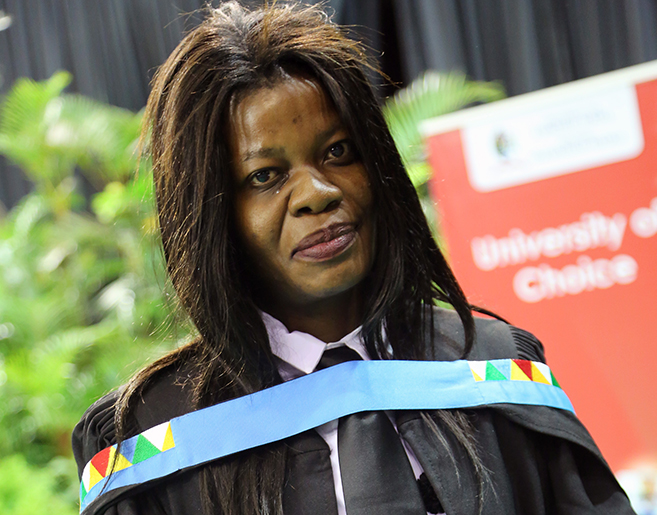 Ms Mbali Sithole graduates with a Bachelor of Education degree.
Losing her hearing and suffering from hemiplegia did not prevent Ms Mbali Sithole from reaching great academic heights. Sithole defied the odds and graduated with a Bachelor of Education at the University of KwaZulu-Natal.
Sithole became deaf and suffered hemiplegia on her right side – paralysis of one side of the body – during her undergraduate studies.
‘My friend Nathan persuaded me to study at UKZN. I didn’t even believe him or even know that universities take deaf students. Being at UKZN has changed my life and this is where I began to pursue my goals. The University has restored what I lost through my disability.’
An inspiration to other physically challenged students, Sithole said: ‘The secret behind my success was praying and working hard. One of the most valuable lessons I have learned is not to compare myself to anyone. I encourage students not to let their disability stop them from achieving their goals. Believe in yourself, everything is possible.’
Due to her hearing impairment and disability, Sithole struggled to find a school at which she could do her teaching practice. Eventually, she was accepted at V N Naik School for the Deaf where she learned sign language.
Sithole now plans to obtain a postgraduate degree and, in time, become a teacher at a school that caters for the hearing-impaired.
She thanked her family, friends and the UKZN Disability Support Unit, for their prayers, motivation and support.
‘To those that are faced with disabilities and various issues, always have faith and believe in yourself. Never let anyone take advantage of your situation,’ said Sithole.
Words: Melissa Mungroo
author : .author email : .Former First Lady Congratulates UKZN Staffer
 Gugu Motlanthe, wife of former President of South Africa Kgalema Motlanthe congratulates her cousin Dr Nompumelelo Thabethe.
South Africa’s former first lady, Gugu Motlanthe, wife of former President Kgalema Motlanthe, was in attendance at the University of KwaZulu-Natal’s Graduation ceremony to congratulate her cousin who graduated with a PhD in Education.
Dr Nompumelelo Thabethe, a lecturer at UKZN graduated this week.
Thabethe looked at epistemological experiences in community-based learning, making critical connections in theory and practice. She argued that there was disjuncture between the current Higher Education Institutions (HEI) system and students epistemological experiences resulting in irrelevant knowledge production.
‘It highlights a shift in knowledge production from traditional students, who are regarded as privileged, to non-traditional students studying communities they share similar struggles with. This exposes the elitist nature of university education and reveals that while HEI systems have transformed structurally, institutional cultures remain untransformed leaving students to balance tensions,’ said Thabethe.
Words by: Melissa Mungroo
author : .author email : .